


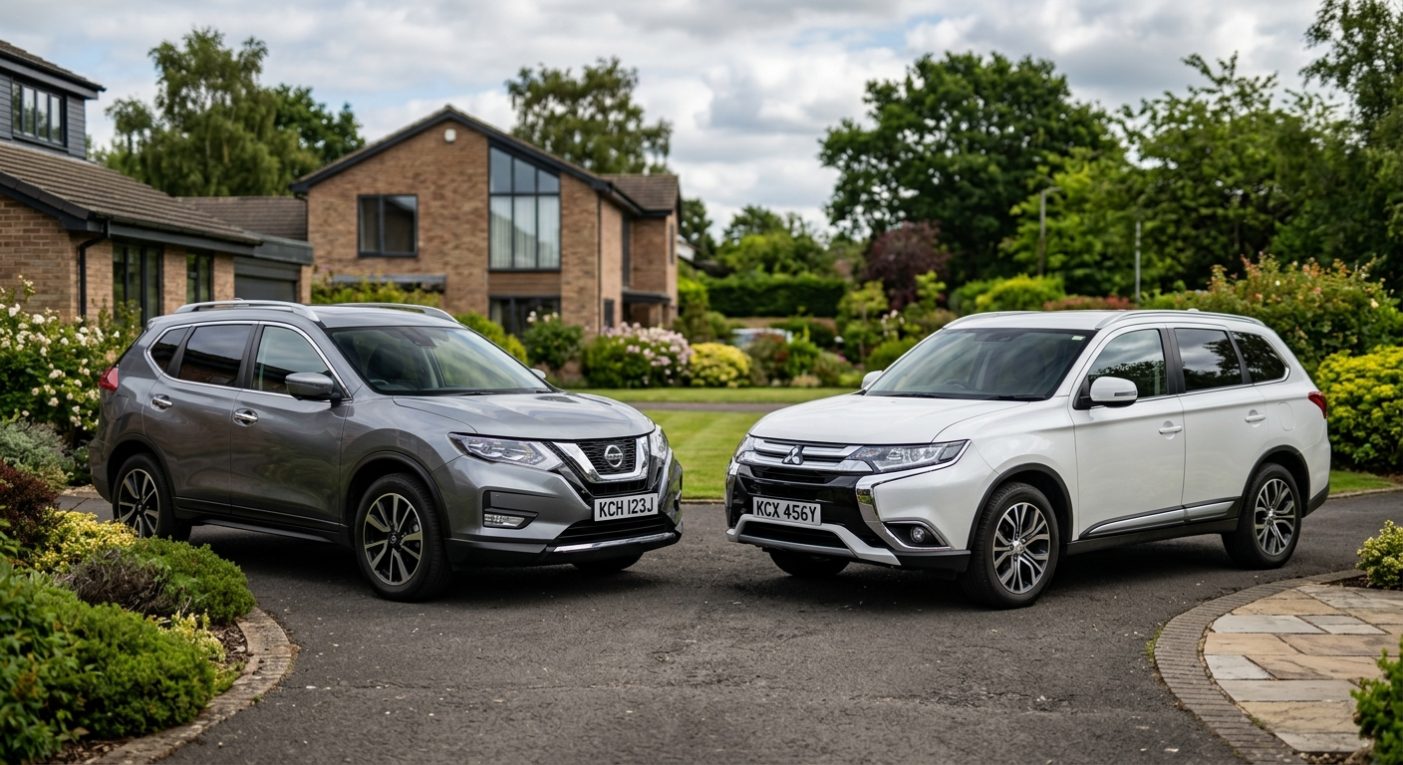
If you need a family SUV in Kenya without moving into the price and size of a Prado, the Nissan X-Trail and Mitsubishi Outlander are two cars that deserve a serious look. Both are Japanese imports, both offer good ground clearance and both are available in Kenya at prices that put them within reach of buyers looking for a practical family SUV. But between them, which one is more practical for a Kenyan family?
The X-Trail Is the More Familiar Choice
The T32 Nissan X-Trail has become a fairly common sight on Kenyan roads. Its relatively upright shape, good ground clearance and available third row make it particularly appealing to families.
The Japanese-market 2.0-litre X-Trail uses the MR20DD petrol engine with a CVT, while different grades are available in both two-wheel-drive and four-wheel-drive configurations. Some versions are five-seaters while others offer seven seats, so buyers should check the exact specification rather than assuming every X-Trail has three rows.
The seven-seat option is probably its biggest practical advantage. The third row isn’t enormous, so it is better suited to children or shorter journeys than to carrying seven adults across the country. But having those extra seats available can make a considerable difference when you have a growing family. With the third row folded away, the X-Trail becomes a much more useful luggage carrier.
The Outlander Takes a Different Approach
The Outlander is arguably the quieter alternative. It doesn’t have the same visibility on Kenyan roads as the X-Trail, but the third-generation model offers much of what a family buyer is looking for: a spacious cabin, available seven seats, reasonable ground clearance and a choice of petrol and plug-in hybrid powertrains.
Also Read
The conventional Outlander was available with 2.0-litre and 2.4-litre petrol engines. Japanese-market specifications show the 2.0-litre using a CVT with front-wheel drive, while the 2.4-litre versions were offered with four-wheel drive.
Then there is the PHEV. That makes the Outlander particularly interesting for a buyer who wants an SUV but is also considering electrification. The plug-in hybrid version combines a petrol engine with electric motors and can operate on electric power for shorter journeys when properly charged.
However, the PHEV is generally a five-seater, so you need to decide whether fuel savings and electrification matter more to you than the extra seats.
Which One Is Better for Kenyan Roads?
Both are reasonably well suited to Kenyan conditions, but neither should be confused with a serious off-road vehicle. The X-Trail has around 200 mm of ground clearance in common T32 configurations, which gives it useful clearance over potholes, speed bumps and rougher sections of road.
The Outlander is similarly comfortable on ordinary Kenyan roads, although the exact clearance varies with specification. Where the two become less comfortable is on genuinely rough terrain.
If your idea of family travel involves regularly leaving the tarmac for badly damaged rural roads, deep mud or rocky tracks, neither would be my first choice. These are family crossovers designed primarily for road use. For Nairobi, highways and the usual mixture of paved and moderately rough Kenyan roads, both are capable.
What About the Engines?
For the X-Trail, the 2.0-litre petrol is one of the most common choices in the Kenyan market. It produces about 145 hp and 207 Nm in the T32 specification, which is adequate for normal family driving but can feel less enthusiastic when the vehicle is heavily loaded.
The Outlander gives you a little more choice. The 2.0-litre petrol is adequate for everyday use, while the 2.4-litre gives the larger SUV more breathing room, particularly when carrying passengers. That extra engine capacity does come with a trade-off: fuel consumption.
Neither vehicle should be bought expecting small-hatchback fuel bills. They are heavier family SUVs, and your fuel consumption will depend heavily on traffic, driving style, load and condition. The PHEV changes that calculation considerably if you can charge it regularly.
For someone doing mostly short urban journeys and with reliable access to charging, the Outlander PHEV can be a very different ownership proposition from the petrol versions.
The CVT Question
Both models deserve some thought here. The X-Trail’s common 2.0-litre T32 uses a CVT, while conventional petrol versions of the Outlander also use CVT transmissions. A CVT isn’t automatically a problem.
But buying a used car with a CVT means you should pay attention to how the transmission behaves and establish whether it has been properly maintained.
During a test drive, look for hesitation, juddering, unusual noises, delayed response or behaviour that feels different from what you would expect. And don’t assume that because a car has only 80,000 or 100,000 km on the odometer, the transmission must be healthy. Service history matters.
What About Maintenance and Parts?
This is where the X-Trail has a practical advantage in Kenya. Nissan has a large local presence, and the X-Trail is common enough that many independent mechanics are familiar with it. Parts are also relatively accessible.
The Outlander is not an orphan by any means. Mitsubishi has been represented in Kenya for years, and parts and specialist support are available. But you are likely to encounter more general familiarity with the X-Trail simply because there are more of them around.
For the PHEV Outlander, however, I would be more deliberate about choosing a mechanic. The hybrid system is more complex than the conventional petrol model, and you want someone who actually understands Mitsubishi’s PHEV system rather than a mechanic who is simply familiar with petrol Outlanders.
And Then There Is the Price
This is where the Outlander can become particularly interesting. Current Kenyan listings for 2018 Outlanders show conventional and PHEV versions advertised at roughly KSh 2.8–3.5 million, although prices vary considerably by specification, mileage and condition.
For the X-Trail, current import and market listings show 2019 2.0-litre examples ranging from roughly KSh 2.7 million into the KSh 3 million-plus range depending on grade and seating configuration.
These aren’t fixed market values. They are asking prices and estimates, and the actual price of a particular car can be very different. But the broader point is important: you don’t necessarily have to pay Toyota money to get a capable family SUV.
Which one makes more sense then? If your priority is easy ownership, local familiarity, seven-seat practicality and access to parts and mechanics, the X-Trail makes a very strong case. The Outlander becomes more interesting if you want something a little different, prefer its driving character or are specifically interested in the PHEV.
For a family that occasionally needs seven seats, the X-Trail’s layout is hard to ignore. For an urban driver who can charge at home or work and wants to reduce petrol consumption, the Outlander PHEV deserves much closer attention. But whichever one you choose, don’t buy based on the model name alone. A well-maintained Outlander is a better purchase than a neglected X-Trail, and vice versa.