


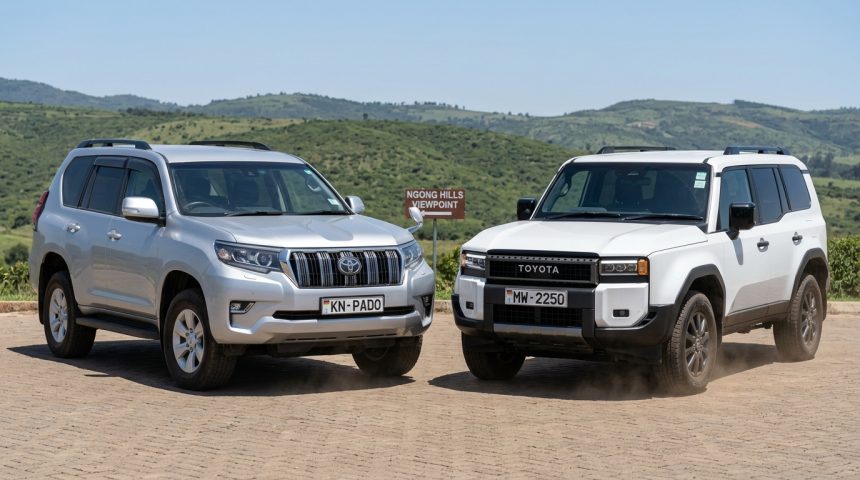
The Toyota Land Cruiser Prado has built a strong following in Kenya, where buyers value its combination of comfort, durability and ability to handle rough roads. The J150 has been a familiar sight for years, but the arrival of the J250 brings a new generation with a noticeably different design and more modern technology.
For someone considering a Prado today, the choice is between the established appeal of the J150 and the updated capabilities of the J250. Both carry the Prado name, but they offer different ownership experiences.
Design: Familiar luxury or a tougher new look?
The J150 has a more rounded and traditional SUV design. Its appearance varies across model years and facelifts, but it generally has a polished look that balances luxury with off-road practicality. Inside, the cabin is comfortable and functional, although older versions can feel dated compared with newer luxury SUVs.
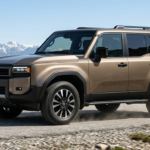
The J250 takes a different direction. Its boxier body, upright front end and more squared-off proportions give it a tougher appearance. Toyota has deliberately drawn on the Prado’s traditional design heritage, particularly in some trim versions.
The interior is also more contemporary, with a larger infotainment display, updated instrumentation and improved connectivity, depending on specification. The J250 feels like a more modern vehicle, while the J150 retains a familiar and relatively straightforward layout.
Performance and off-road capability
Both generations are designed to handle more than ordinary tarmac driving. Their four-wheel-drive systems, high ground clearance and off-road engineering make them suitable for rough roads, countryside travel and challenging terrain.
The J150 has earned its reputation through years of use in different conditions. Depending on the model year and market, it is available with petrol and diesel engines, including the 2.8-litre diesel and earlier 3.0-litre diesel options. Some versions also have larger petrol engines.
The J250 introduces a newer platform and updated powertrain options. The 2.8-litre diesel remains available in several markets, while other regions offer different petrol and electrified configurations. Engine availability depends on the market and specification.
On the road, the J250 benefits from a newer chassis and updated suspension engineering. It is designed to improve ride comfort, handling and stability without abandoning the Prado’s off-road character. However, the J150 is hardly out of its depth. For buyers who regularly travel on rough Kenyan roads, a well-maintained J150 remains a capable vehicle.
Comfort, technology and everyday driving
This is where the age difference becomes more apparent. The J150 provides a comfortable driving experience, particularly in higher-specification versions. It has generous cabin space, a commanding driving position and enough room for family travel. However, infotainment, driver assistance and interior technology depend heavily on the model year.
The J250 brings more recent safety and convenience features, including newer driver-assistance technologies, improved connectivity and a more modern dashboard. Exact equipment varies by trim and market.
Both are relatively large SUVs, so neither is particularly small for navigating crowded Nairobi streets or squeezing into tight parking spaces. The J250’s more modern driving assistance systems may make everyday use easier, but they do not change the vehicle’s overall size.
Ownership costs in Kenya
For many buyers, this is the deciding factor. The J150 has a major advantage: it has been on Kenyan roads for years. Mechanics are generally more familiar with its common engine and drivetrain configurations, and there is an established market for replacement parts. Buyers also have a wider range of used vehicles and prices to consider.
That does not make every J150 cheap to maintain. It remains a large, relatively sophisticated SUV, and neglected units can develop expensive problems involving the transmission, suspension, cooling system or four-wheel-drive components.
The J250 is newer and comes with more advanced electronics and technology. Its purchase price is considerably higher, and some replacement components may be less readily available or more expensive. As more units enter the market, familiarity and parts support should improve, but buyers should not assume that servicing costs will match those of the older generation.
Fuel consumption also depends on the engine, transmission, driving conditions and vehicle condition. A J150 with an older engine should not automatically be compared with a J250 diesel using general fuel-economy assumptions.
So, which should you buy? Well, the J150 makes more financial sense for buyers who want the Prado experience without paying the premium for the latest generation. A clean, well-maintained unit can still deliver excellent practicality, comfort and off-road capability.
The J250 is the better choice for buyers who prioritise modern technology, updated safety features, a newer platform and the appeal of owning the latest Prado. However, the higher purchase price and potentially higher parts and repair costs need to be considered.
Ultimately, the J150 is the established choice, while the J250 represents the Prado’s next chapter. If your budget allows for the newer model, the J250 brings meaningful improvements. But if you are shopping for value, a carefully inspected J150 remains a very compelling option.