

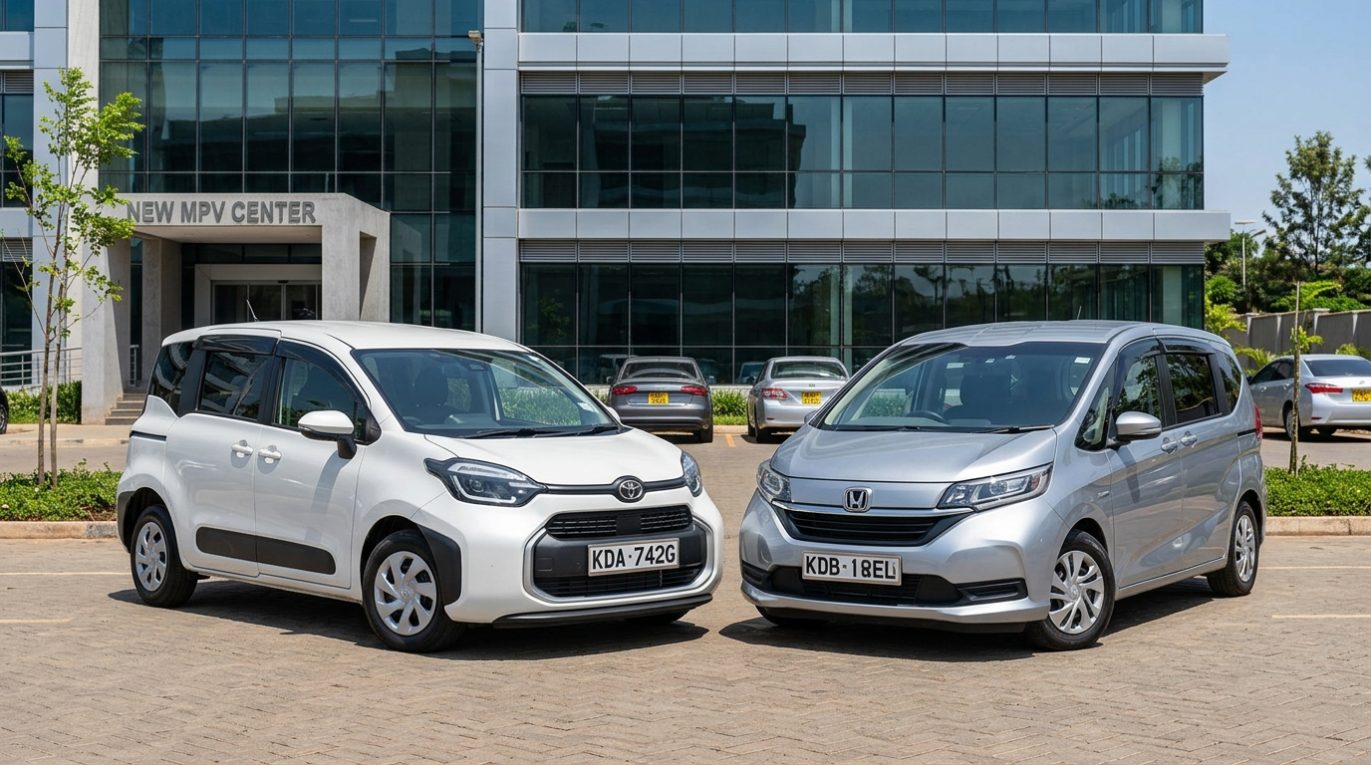
If you need a family car with three rows of seats but do not want the size and running costs of a large van, the Toyota Sienta and Honda Freed deserve a place on your shortlist. Both are compact Japanese MPVs with sliding doors, flexible seating and engines designed for everyday use. They are particularly useful for families navigating busy estates, school runs and tight parking spaces.
The Toyota Sienta has a strong advantage in familiarity and resale demand in Kenya. The Honda Freed, however, offers a slightly different appeal, with a well-designed cabin and seating arrangements that can make family travel more comfortable. Choosing between them comes down to what you value most.
Space and everyday practicality
Both cars make clever use of a relatively small body. Their sliding rear doors are particularly useful in crowded parking areas, where opening a conventional door fully can be difficult. They also make it easier to help children and older passengers get in and out.
The Sienta’s cabin is designed around practicality. Its three-row layout suits families who occasionally need extra seats, while its compact dimensions make it easy to manoeuvre around Nairobi. The third row is best treated as occasional seating, particularly for adults on longer journeys. With all seats in use, luggage space becomes limited.
The Freed is similarly versatile, but some versions have a six-seat layout with individual middle-row captain’s seats, creating a passage to the rear. Other versions offer different seating configurations, so buyers should check the actual vehicle rather than assume every Freed has the same arrangement. Its cabin can feel a little more refined, although neither vehicle should be mistaken for a large family van.
If you regularly travel with seven adults and substantial luggage, both may feel cramped. For a family that mostly carries four or five people and occasionally needs extra seats, however, they offer a sensible compromise.
Fuel economy and performance
The second-generation Sienta, introduced in 2015, is commonly found with a 1.5-litre petrol engine or a 1.5-litre hybrid powertrain. The Freed generation launched in 2016 also offers 1.5-litre petrol and hybrid versions. Their fuel consumption depends on the exact version, condition and driving environment, so advertised Japanese test figures should not be treated as guaranteed Kenyan results.
The Sienta hybrid is particularly attractive for drivers who spend much of their time in stop-start traffic. Its Toyota hybrid system has a well-established presence in Kenya, and many local mechanics are familiar with Toyota hybrid vehicles. The petrol version is worth considering too, especially if its purchase price and condition make better financial sense.
The Freed hybrid can also be economical, but it requires a closer look at the specific powertrain. Many second-generation Japanese Freed hybrids use Honda’s seven-speed dual-clutch i-DCD transmission rather than Toyota’s familiar hybrid arrangement. A proper inspection of the transmission, service history and hybrid system is therefore essential. Honda’s official specifications confirm that the hybrid powertrain and its fuel economy vary by model and test cycle.
For either car, do not buy on fuel economy claims alone. A neglected hybrid or a vehicle with transmission problems can quickly erase the savings you expected at the petrol station.
Maintenance, parts and resale in Kenya
This is where the Sienta often makes the stronger case. Toyota has a broad service and parts network in Kenya, and the brand enjoys strong recognition in the used-car market. That can make repairs easier to arrange and resale more straightforward, although the cost and availability of specific components still depend on the model and year.
The Freed is not automatically expensive or unreliable to maintain. However, buyers should be more deliberate about finding a mechanic familiar with the exact Honda engine and transmission, especially on hybrid versions. Before committing, confirm that the workshop can diagnose the vehicle properly and source the parts it may need.
Both vehicles also have relatively low ground clearance compared with SUVs. They are well suited to ordinary urban roads, but tall speed bumps, deep potholes and rough estate access roads require care. Inspect the suspension, tyres and underbody, particularly if the car has been used locally for several years.
Which one should you buy?
For most Kenyan families, the Toyota Sienta is the sensible starting point. Its familiarity, established hybrid support and strong resale appeal make it an attractive all-round choice, especially if low running costs and ease of ownership are priorities.
The Honda Freed deserves serious consideration if you prefer its cabin layout, want captain’s seats in the middle row or find a particularly clean example at a competitive price. Just make sure the seating configuration suits your family and that the vehicle’s mechanical and hybrid systems check out.
Before buying either, inspect the engine, transmission, hybrid battery where applicable, sliding doors, air conditioning and service history. Do not assume a newer vehicle is automatically in better condition.