

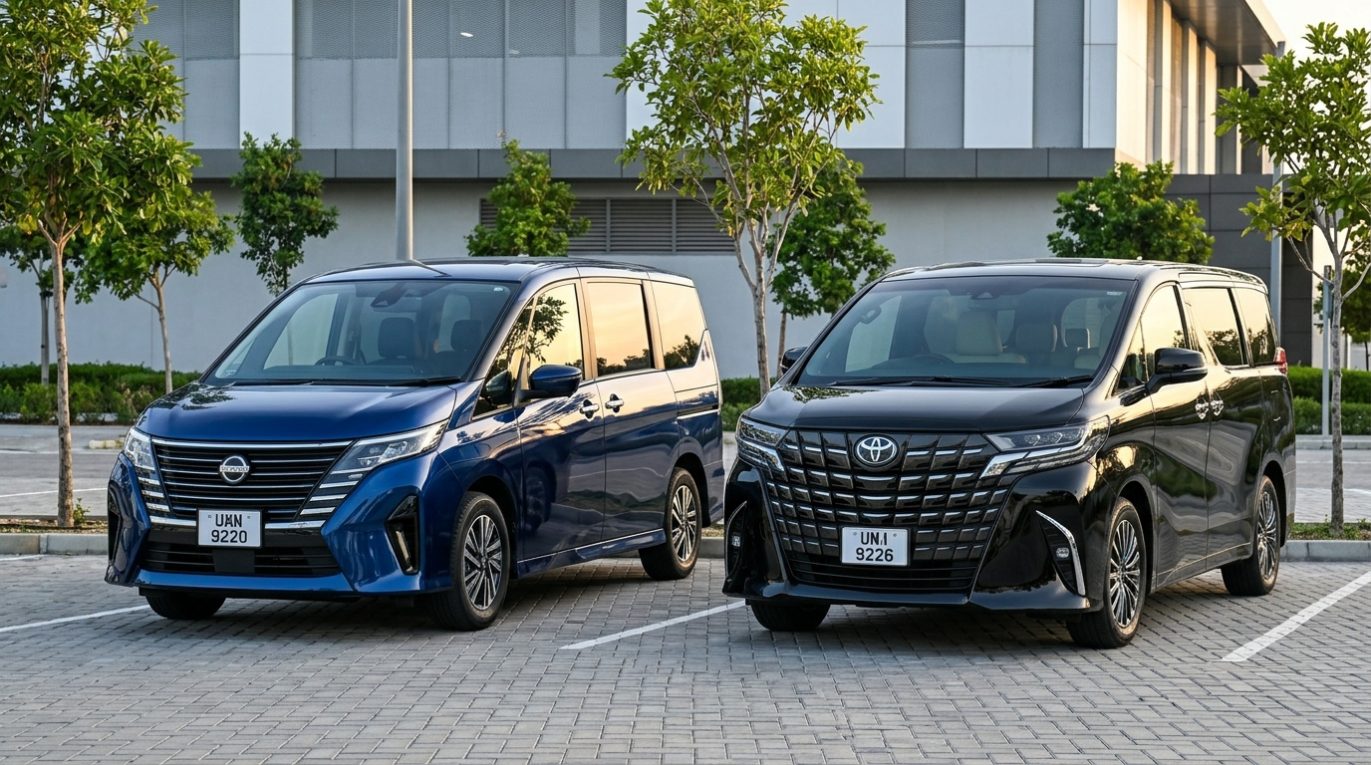
If you are shopping for a spacious family van in Kenya, the Nissan Serena and Toyota Alphard are two vehicles worth considering. Both offer sliding doors, flexible seating and generous cabin space, but they target slightly different buyers.
The Nissan Serena is designed around practical family transportation, with an emphasis on space, convenience and affordability. The Toyota Alphard, on the other hand, is positioned as a more luxurious people-carrier, offering a premium cabin and a more refined passenger experience.
The difference becomes particularly important in the used-car market, where the Alphard generally commands a higher purchase price. But does its additional luxury justify the extra expense?
Design, space and interior comfort
The Nissan Serena has a conventional family-MPV design, with a tall body, large windows and sliding rear doors that make passenger access easier. Its interior is designed to accommodate families, with flexible seating arrangements and convenient storage spaces. Depending on the generation and specification, it comes with seven- or eight-seat configurations.
The Toyota Alphard takes a more luxurious approach. Its exterior is larger and more imposing, while the cabin places greater emphasis on passenger comfort. Higher-grade versions feature premium upholstery, captain’s chairs, powered seats, advanced climate control and additional entertainment features.
The Alphard’s second-row seating is one of its strongest attractions, particularly in versions with executive-style captain’s chairs. Passengers have generous legroom and a more relaxed seating position, making it particularly appealing for executive transport and long-distance family travel.
Both vehicles can accommodate larger families, but their third rows and luggage capacity depend on the seating configuration. With all seats occupied, luggage space becomes limited, so buyers who regularly travel with several passengers should inspect the available boot space carefully.
For everyday family use, the Serena provides plenty of practicality. The Alphard is the more appealing option when passenger comfort and a premium experience are priorities.
Engine performance and fuel consumption
The two vehicles have several engine options, depending on their generation and market specification.
Many Nissan Serena imports are fitted with a 2.0-litre petrol engine paired with a continuously variable transmission (CVT). Some versions use Nissan’s S-Hybrid system, which provides mild-hybrid assistance. Newer models also include e-POWER versions, where a petrol engine generates electricity while an electric motor drives the wheels. These systems should not be confused with conventional petrol hybrids.
The Alphard offers 2.5-litre petrol, 2.5-litre hybrid and, in some generations, 3.5-litre V6 petrol options. The hybrid versions combine a petrol engine with electric motor assistance, while the V6 provides stronger performance at the expense of higher fuel consumption.
For urban driving in Nairobi, the Serena e-POWER can be particularly attractive because of its smooth electric-motor-driven operation and potential fuel savings. The Alphard hybrid is also worth considering for buyers who want a large, comfortable vehicle with hybrid efficiency.
However, actual fuel consumption depends on the specific generation, traffic, passenger load, driving style and mechanical condition. Neither vehicle should be purchased based solely on advertised fuel-economy figures.
Driving experience and suitability for Kenyan roads
The Serena is relatively easy to drive for a vehicle of its size. Its visibility, sliding doors and practical cabin layout make it suitable for school runs, family errands and urban transport. Its size still requires some adjustment when parking, but it does not feel as imposing as the Alphard.
The Alphard feels more substantial on the road. Its longer wheelbase and emphasis on passenger comfort contribute to a relaxed highway experience. It is particularly suited to motorists who frequently travel with family or clients over longer distances.
However, the Alphard’s size and relatively low ground clearance require caution on rough roads and high speed bumps. The Serena also needs careful handling over uneven surfaces, although ground clearance varies by generation and specification.
Neither is intended for serious off-road driving. If your daily routes include poorly maintained estate roads, inspect the underbody, suspension and tyres before buying either vehicle.
Maintenance, parts and ownership costs
This is where the Nissan Serena can make a stronger financial case. Its purchase price is generally more accessible than that of a comparable Toyota Alphard, leaving buyers with more room in their budget for servicing and other ownership expenses.
The Alphard benefits from Toyota’s established parts and servicing network in Kenya. Routine mechanical components are generally easier to source, although luxury-specific equipment, body parts and hybrid components can still be expensive. Its higher purchase price also means insurance and some replacement components may cost more.
The Serena is not necessarily expensive to maintain, but buyers should pay particular attention to its transmission and hybrid system. The conventional 2.0-litre versions use a CVT that requires the correct maintenance and fluid specification. On e-POWER models, the high-voltage electrical system should be inspected by a technician familiar with Nissan’s technology.
For the Alphard, check the condition of the hybrid battery. Also test the electric sliding doors, air conditioning, powered seats and other electronic equipment. Repairs to luxury features can add considerably to ownership costs.
Serena or Alphard: Which should you buy?
The Nissan Serena makes more sense for buyers who want a spacious, practical family van without spending as much as they would on an Alphard. It is particularly attractive for large households, daily urban transport and buyers interested in the e-POWER technology.
The Toyota Alphard is better suited to those who prioritise passenger comfort, premium features and a more luxurious travel experience. It also has an established resale market in Kenya, which can be an advantage when it is time to sell.
Ultimately, the decision comes down to what you expect from your vehicle. If you need a practical family van that offers good space and convenience, the Serena is a practical choice. If your budget allows and you want something closer to a luxury passenger vehicle, the Alphard is worth the additional investment.