


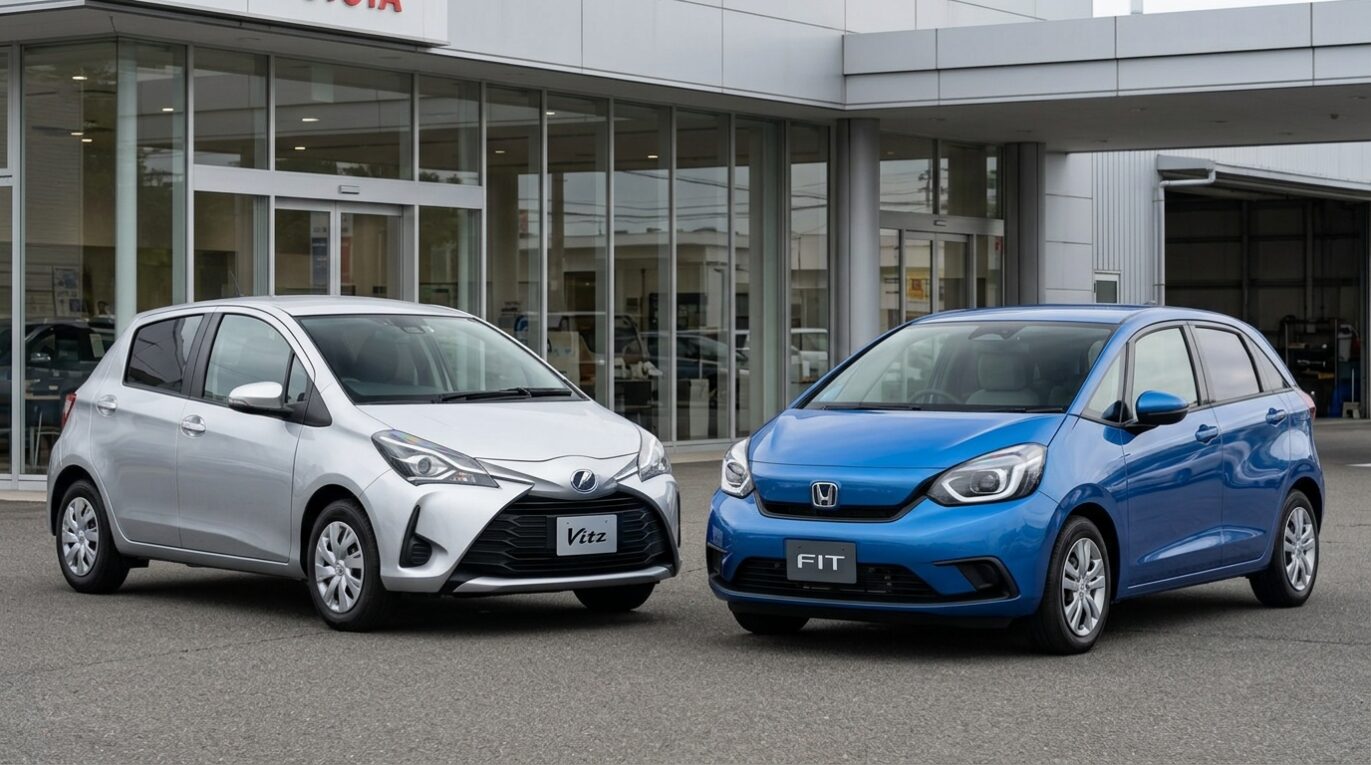
If you are looking for a small, economical car in Kenya, there is a good chance you will eventually find yourself comparing a Toyota Vitz with a Honda Fit.
Both are compact Japanese cars that have become familiar on Kenyan roads. Both are relatively easy to drive in town, economical compared with larger vehicles and available in a wide variety of specifications. They also occupy a similar part of the used-car market, which makes the choice less obvious than it first appears.
The Vitz, however, has something of a head start in Kenya. Toyota’s reputation for reliability, readily available parts and strong resale value has made it a favourite for years. The Honda Fit has fewer units on Kenyan roads but has its own advantages, particularly when it comes to interior space and practicality. So if you had to choose between the two, which one makes more sense for Kenyan roads?
The Vitz Has the Easier Ownership Story
The biggest advantage of the Toyota Vitz is not necessarily something you notice during a test drive. It is what happens after you buy it.
Toyota has a huge presence in Kenya, which means mechanics are generally familiar with the brand and replacement parts are widely available. This can make routine maintenance and repairs relatively straightforward.
The Vitz also has a strong reputation in the local used-car market. That matters when you eventually want to sell it. A car that is familiar to buyers tends to be easier to move than one that requires you to explain why they should consider it.
This doesn’t mean every Vitz is reliable simply because it is a Toyota. Condition, maintenance and the specific engine and transmission fitted to the car still matter.
But when two cars are otherwise comparable, the Vitz has an advantage in Kenya simply because the ownership ecosystem around it is so well established.
The Honda Fit Makes Surprisingly Good Use of Its Size
The Fit’s biggest trick is space. From the outside, it is a small hatchback. Inside, Honda has designed the cabin to be remarkably versatile. The rear seats can be folded and configured in ways that make the car more useful for carrying different types of cargo. That matters if the car is going to serve as more than just a commuter.
You can use it for the daily trip to work, shopping, family errands and occasional longer journeys without feeling that you have bought a car that is simply too small.
The Fit can also feel more spacious inside than you might expect from its exterior dimensions. For someone who values practicality and interior flexibility, this is where the Honda begins to make a strong case for itself.
Which One Is Better on Kenyan Roads?
Neither car was designed to be an off-road machine, and neither should be treated like one. For Nairobi and other urban environments, both are well suited to the job. Their compact dimensions make parking easier and allow you to negotiate traffic without the bulk of a larger SUV.
The bigger question is how much rough-road driving you do. Ground clearance varies according to the exact generation and specification, so buyers should check the particular vehicle rather than relying on a generic figure for the entire model. Low-profile tyres and larger wheels can also make some versions less comfortable on rough surfaces.
If your daily route includes badly damaged roads, deep potholes or poorly designed speed bumps, inspect the actual car carefully before buying. Suspension condition and tyre choice may matter more to your experience than the badge on the bonnet. For normal urban and highway driving, however, both can handle Kenyan conditions quite comfortably.
Fuel Economy: Both Are Economical
Fuel economy is one of the reasons these two cars are so popular. Both are available with small-displacement petrol engines, while certain generations and Japanese-market variants are also available as hybrids. The exact fuel consumption therefore depends heavily on the particular version.
This is important because it is easy to see an impressive Japanese catalogue figure and assume you will achieve the same number in Nairobi traffic. You probably won’t. Traffic, driving style, air conditioning, tyre pressure, vehicle condition and the amount of time spent idling can all affect real-world consumption.
For a normal petrol Vitz versus a normal petrol Fit, the difference in fuel costs may not be large enough to make the decision by itself. If you’re comparing hybrid versions, however, the calculation changes and you need to look at the particular hybrid system rather than simply comparing the badges.
In other words, buying a Vitz or Fit purely because someone promised you a particular kilometres-per-litre figure is a mistake.
What About Reliability?
This is where the conversation usually becomes very Toyota-heavy. The Vitz has the stronger reputation in Kenya, but the Fit should not be dismissed as an unreliable car. Honda has produced millions of Fits globally, and a well-maintained example can serve its owner for many years.
The challenge is buying the right one. Different generations of the Fit have used different engines, transmissions and hybrid systems. Some Japanese-market Fits have also used Honda’s dual-clutch hybrid technology, which is mechanically different from the conventional Toyota hybrid systems many Kenyan mechanics are familiar with.
That means you shouldn’t treat every Fit as mechanically identical. A buyer should identify the exact generation, engine and transmission before purchasing and make sure the vehicle is inspected by someone familiar with that particular setup. The same principle applies to the Vitz. Toyota is not a substitute for inspection.
Spare Parts and Maintenance Give the Vitz an Edge
This is probably the most practical difference for a Kenyan buyer. Because Toyota is so deeply established in Kenya, finding mechanics and parts for common Vitz variants is generally easier.
That doesn’t mean Honda parts are impossible to find. They are available, particularly in major towns. But depending on the specific Fit variant, some components may not be as readily available off the shelf as their Toyota equivalents.
For someone who wants a car that can be maintained almost anywhere without much searching, the Vitz has the advantage. For a buyer in Nairobi who has access to a reliable Honda specialist, however, this disadvantage becomes much smaller.
Which One Is Better for a First-Time Buyer?
This is where I would lean toward the Vitz. Not necessarily because it is the better car in every respect, but because it is an easier ownership proposition for someone who doesn’t want to spend too much time figuring things out.
There is a huge amount of local knowledge around Toyota. Mechanics know the cars. Parts are widely available. Buyers know them. Sellers know them. That makes the learning curve shorter.
The Fit makes more sense for someone who values its interior flexibility, driving character or particular specification and is prepared to find a competent Honda specialist when necessary.
So, which one should you buy? If your priority is easy ownership, parts availability, resale value and widespread mechanical support, the Toyota Vitz is the safer choice for the Kenyan market. If you want a practical compact car with clever interior space and don’t mind a slightly less ubiquitous ownership ecosystem, the Honda Fit deserves serious consideration.
And if you’re comparing hybrid versions, slow down before making the decision. Identify the exact hybrid system and transmission first. Two cars that look similarly economical on paper can have very different maintenance considerations. Most importantly, don’t let brand reputation make the decision for you. A clean, well-maintained Honda Fit is a better buy than a neglected Toyota Vitz.