

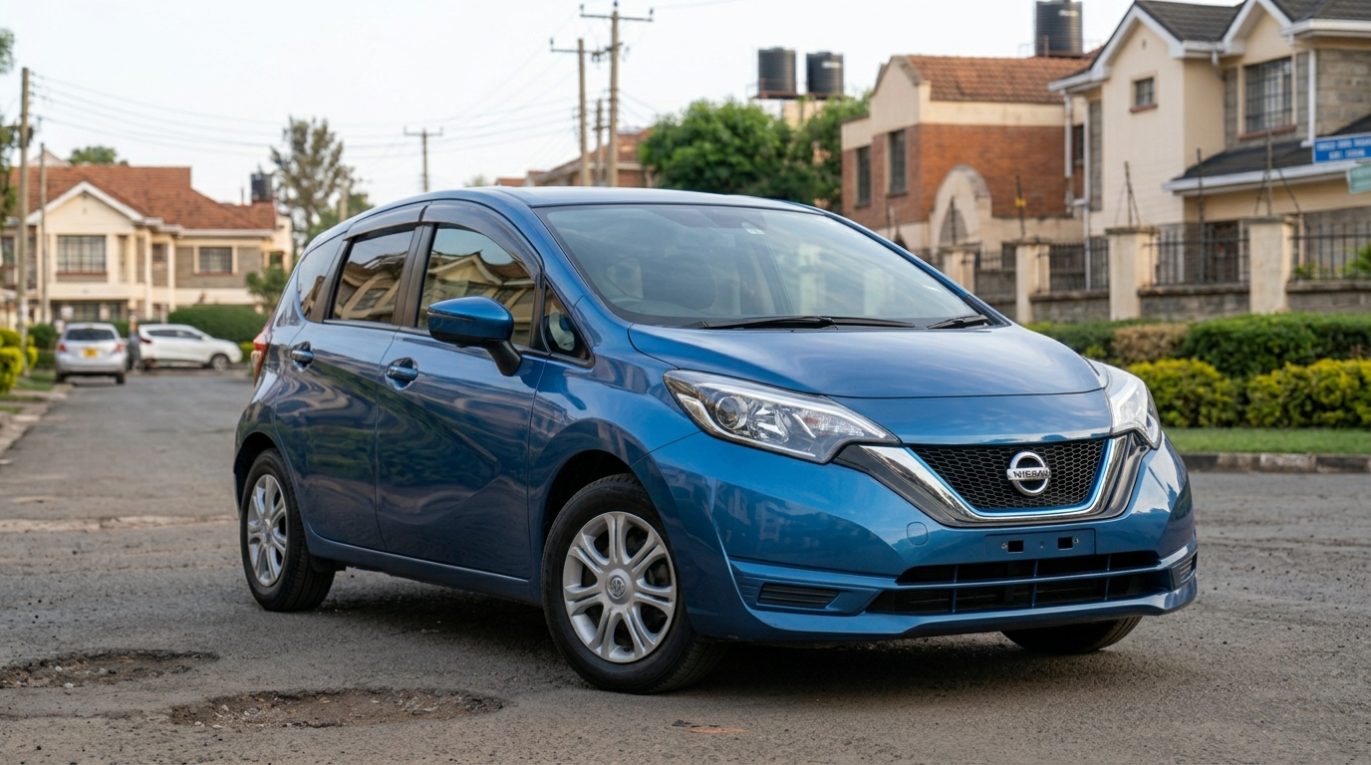
The Nissan Note is one of those cars that can easily be underestimated. From the outside, it looks like an ordinary compact hatchback, but step inside and you discover a surprisingly spacious cabin designed around everyday practicality.
In Kenya, the Note appeals to buyers looking for an affordable car that can handle commuting, school runs and family errands without the fuel consumption and parking challenges associated with larger vehicles. It also offers something interesting for motorists considering hybrid technology: the Nissan Note e-POWER. But is it a good family car, and which version should you consider?
Design and interior space
The second-generation Nissan Note, commonly identified by its E12 model code, has a tall, compact body that prioritises interior space over sporty styling. Its proportions make it easy to manoeuvre in town, while the relatively upright cabin provides good headroom for occupants.
The front seats offer a comfortable driving position, and visibility is generally good. The dashboard layout is straightforward, although the design and equipment vary depending on the grade.
Where the Note makes a particularly strong impression is at the back. The rear bench provides reasonable legroom for a car of this size, making it suitable for families who regularly travel with children or adult passengers. Getting in and out is also relatively easy because of the car’s tall roofline and wide door openings.
However, the boot is not particularly large. It can accommodate everyday shopping and smaller luggage, but families travelling with several suitcases may find the available space restrictive. The rear seats can be folded to create additional carrying room.
The Note is therefore a practical family hatchback, although buyers should not confuse its spacious cabin with the luggage capacity of a larger station wagon or SUV.
Engine performance and fuel consumption
The E12 Nissan Note is available with different 1.2-litre three-cylinder petrol engines, depending on the grade. The standard HR12DE is naturally aspirated, while the HR12DDR uses supercharging to provide additional performance.
There is also a 1.6-litre engine in the sportier Nismo S version, although this is less common in the Kenyan market.
For ordinary family use, the naturally aspirated 1.2-litre engine provides adequate performance, particularly when driving around town without a heavy passenger load. However, its modest output becomes more noticeable when climbing steep hills, overtaking or travelling with a fully occupied cabin.
The supercharged version offers stronger acceleration, making it a more appealing option for drivers who want additional performance without moving to a larger engine.
The other major attraction is the Note e-POWER, introduced in the E12 range in 2016. Unlike a conventional petrol hybrid, the e-POWER uses a petrol engine to generate electricity, while an electric motor drives the wheels. This gives it a driving experience closer to an electric vehicle, with smooth acceleration and immediate electric-motor response.
For motorists who spend considerable time in Nairobi traffic, the e-POWER can be particularly appealing. However, buyers should understand that it is not a plug-in vehicle and does not need to be charged from an external power source.
Fuel consumption varies with traffic, driving habits, mechanical condition and the specific version. The e-POWER can be economical in urban conditions, but advertised figures should not be treated as guaranteed real-world consumption.
Driving experience and suitability for Kenyan roads
The Nissan Note is primarily designed for urban driving. Its compact dimensions make it convenient in traffic, while the light steering helps when manoeuvring through narrow streets and parking spaces.
The standard petrol version provides a fairly conventional driving experience. Its continuously variable transmission (CVT) is designed to deliver smooth acceleration rather than the distinct gear changes of a traditional automatic transmission.
The e-POWER feels different. Its electric motor provides smooth, immediate response, which makes moving through stop-start traffic particularly pleasant. It also has a more noticeable regenerative braking effect, depending on the selected driving mode.
However, the Note is not particularly suited to rough roads or serious off-road driving. Its ground clearance is relatively modest, and the front bumper can scrape on steep ramps, poorly designed speed bumps and uneven surfaces.
For buyers living in areas with reasonably maintained roads, it should be comfortable enough for everyday use. Those who regularly travel on rough rural roads may be better served by a vehicle with greater ground clearance and more suspension travel.
Maintenance, reliability and common concerns
The Nissan Note has a relatively straightforward mechanical layout in its conventional petrol versions, but the transmission deserves attention. The CVT should be checked for unusual noises, juddering, delayed engagement and inconsistent acceleration. Buyers should also establish whether the correct transmission fluid has been used and whether servicing has followed the manufacturer’s recommendations.
The e-POWER requires additional attention because of its electrical drivetrain. The high-voltage battery, electric motor, generator and associated electronic systems should be inspected by a technician familiar with Nissan’s e-POWER technology. Warning lights or unusual behaviour should never be dismissed simply because the car still drives.
Suspension condition is another consideration, particularly on vehicles that have covered high mileage or spent time on rough roads. Check the shocks, bushes, links and wheel bearings during a pre-purchase inspection.
Parts availability is generally manageable for common Note models in Kenya, although specialised e-POWER components may require more careful sourcing and a workshop with the right diagnostic equipment.
Is the Nissan Note worth buying in Kenya?
The Nissan Note makes a convincing case for buyers who need a compact, economical and reasonably spacious family car. It is easy to drive, practical in town and offers more interior room than its exterior dimensions suggest.
The standard 1.2-litre petrol version is worth considering if you want a relatively simple everyday hatchback. The e-POWER is more attractive if you prioritise smooth urban driving and want the benefits of electric-motor propulsion without charging the vehicle.
However, buyers should not choose purely on fuel economy or purchase price. Check the transmission, suspension and service history carefully, and have the e-POWER system professionally assessed where applicable.
Ultimately, the Note is not a replacement for a large family SUV or estate car. But for a household that wants a practical five-seater for commuting, shopping and occasional family trips, it is one of the more interesting options in the compact hatchback segment.