


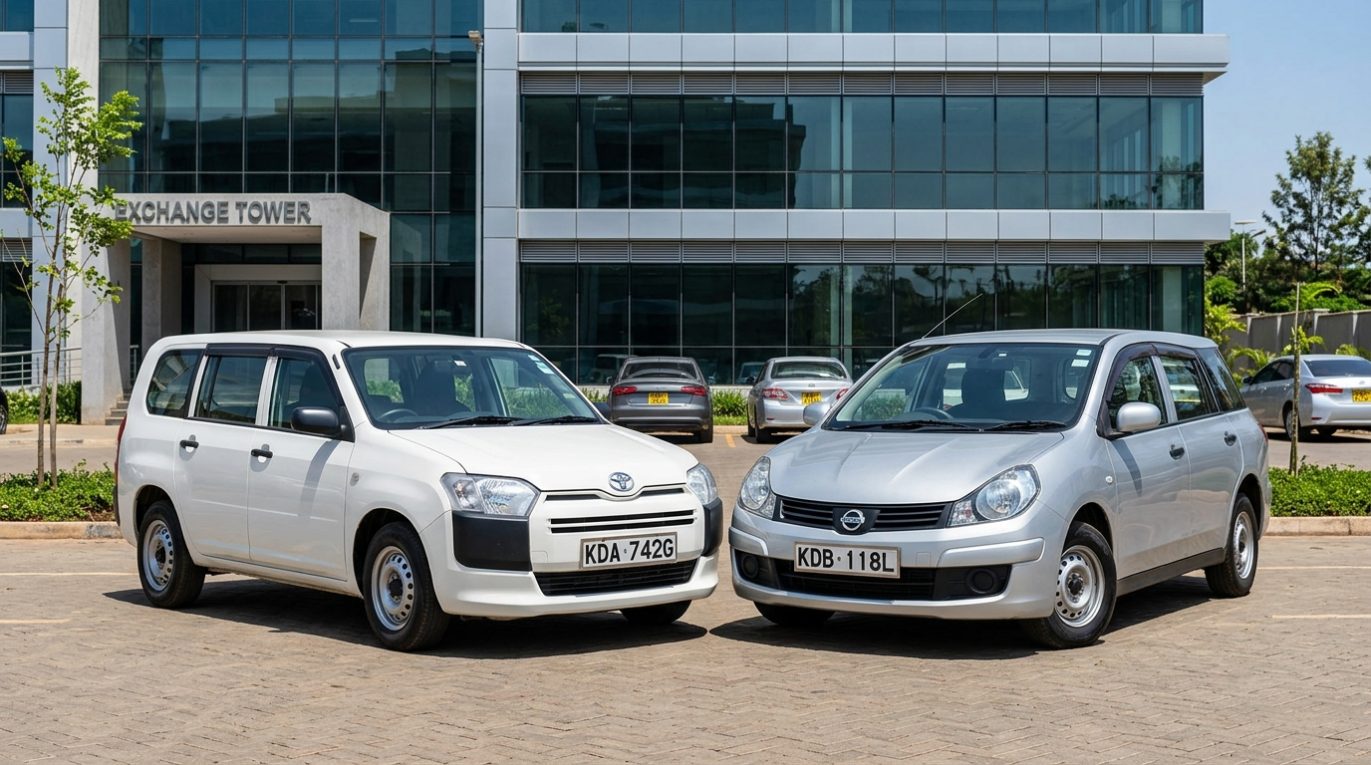
If you are starting a small delivery business in Kenya, supplying shops, carrying farm produce, running a hardware business or simply need a vehicle that can spend most of its day working rather than sitting at home, the Toyota Probox and Nissan AD Van are two names you are likely to encounter.
Neither is trying to be luxurious. These are practical Japanese wagons designed around a simple idea: carry things, move around cheaply and keep working.
The Toyota Probox has become almost synonymous with the small business vehicle in Kenya. The Nissan AD Van, meanwhile, tends to sit in its shadow. That does not necessarily mean it is the worse vehicle. In fact, the AD has some qualities that can make it particularly attractive to someone who spends long hours behind the wheel.
So, between a Toyota Probox and Nissan AD Van, which one makes more sense for a Kenyan business? The answer depends on what you are asking the vehicle to do.
Toyota Probox
The Probox has a major advantage before you even start comparing specifications: Kenya already knows it extremely well.
It has been on Kenyan roads for years and is widely used by traders, technicians, farmers, distributors and delivery businesses. Parts are familiar to mechanics, used components are readily available and there is a large pool of people who understand the vehicle.
That matters more for a business vehicle than it might for an ordinary personal car. When your vehicle is earning money, downtime has a cost. If a mechanic can quickly diagnose a problem and the required part is readily available, the vehicle can potentially get back to work sooner.
The Probox also has the sort of simple, boxy cargo area that makes it easy to use as a work vehicle. Fold the rear seats and there is a large, relatively straightforward loading space. The 2014 facelift brought newer engine and transmission options, and the Probox has continued to be sold in petrol and hybrid forms in Japan.
For someone whose priority is simply getting goods from A to B, the Probox’s basic nature is actually one of its strengths.
Nissan AD Van
The Nissan AD Van takes a slightly different approach. The fourth-generation Y12 AD, which is common in the Kenyan used-import market, is also a practical commercial wagon, with the 1.5-litre HR15DE being one of the common choices.
Some versions are available with 1.6-litre engines and four-wheel drive. The AD was facelifted in 2016 and marketed in Japan as the NV150 AD. One of its biggest attractions is that it can feel more like a passenger car from behind the wheel.
The cabin is reasonably practical, and some AD variants offer thoughtful touches aimed at people who spend their working day inside the vehicle. That can make a difference if you are doing sales calls, deliveries or travelling between towns rather than simply moving goods around a local area.
Comparison
The Probox, by comparison, feels more unapologetically commercial. Its interior is basic because it was designed to be used rather than admired. That difference becomes important when the vehicle is your office for eight or ten hours a day.
Fuel economy is another reason both vehicles remain popular. The exact figure you get will depend heavily on the engine, transmission, load, traffic and driving style, so it is better not to treat advertised fuel-consumption figures as guarantees. A lightly loaded 1.3-litre Probox driven gently around town will obviously use less fuel than a heavily loaded 1.5-litre vehicle fighting Nairobi traffic all day.
The same applies to the AD Van. For business owners, however, the 1.5-litre versions deserve particular attention. The smallest engine may look attractive because of its potential fuel economy, but a vehicle that regularly carries heavy goods needs enough power to do the job comfortably.
There is little point saving money on fuel only to make the engine work unnecessarily hard every time you climb a hill or accelerate with a full load. This is one area where the type of business matters more than the badge.
If you are delivering light parcels, medicines, documents or small electronics around Nairobi, a smaller-engine vehicle can make plenty of sense. If you are regularly carrying heavier goods and travelling longer distances, the 1.5-litre versions are likely to be more suitable.
Price and Resale
Then comes one of the biggest differences between these two vehicles: purchase price and resale. The Nissan AD generally offers an opportunity to enter the market for less money than an equivalent Probox, although actual prices vary considerably depending on year, mileage, grade, condition and whether the vehicle is locally used or a fresh import.
Current Kenyan market listings show a wide spread for both models, with AD Vans generally positioned below comparable Proboxes. That lower entry price can be important for a small business that needs to preserve working capital.
But there is another side to the calculation. The Probox has stronger demand in Kenya, and that gives it an advantage when you eventually want to sell. A business owner who buys a Probox today has access to a much larger pool of potential buyers when the time comes to replace it.
The AD Van can be harder to sell quickly, particularly if buyers in your area are more accustomed to Toyota. That does not make it a bad vehicle, but resale should be part of the calculation when the vehicle is being bought as a business asset.
Ownership
Maintenance is where the difference becomes even more interesting. Both vehicles can be economical to operate when properly maintained. But commercial use is demanding. A vehicle that spends every day carrying loads over rough roads will experience much more stress than one being used occasionally for personal errands.
With either model, inspect the suspension carefully before buying. Look at the shock absorbers, bushes, wheel bearings, tyres and underside of the vehicle. Check the cargo area for signs that it has been heavily abused.
The transmission deserves particular attention as well, especially on used AD Vans and Proboxes fitted with CVT transmissions. Do not assume that because a CVT feels smooth during a short test drive it has been properly maintained. Ask for service records and investigate any whining, hesitation, juddering or unusual behaviour.
Both vehicles are relatively compact and easy to manoeuvre in urban areas, which is useful for deliveries. But neither should be treated like a proper off-road vehicle. A business owner who regularly travels on rough rural roads should pay close attention to ground clearance, tyre condition and suspension rather than assuming that a commercial wagon can tolerate unlimited abuse.
The Probox does have a reputation for being particularly well suited to Kenyan working conditions, and its established support network adds to that appeal. The AD, however, should not be dismissed simply because it wears a Nissan badge. Its 1.5-litre versions can offer useful performance, and the vehicle’s more car-like cabin can be a genuine advantage for someone who spends long hours driving.
So which one is better for a Kenyan business? If your priority is parts availability, widespread mechanical knowledge, resale demand and a straightforward work-focused vehicle, the Probox is the more familiar choice. If your priority is getting into a practical work vehicle for less money and having a somewhat more comfortable driving environment, the AD Van deserves a serious look.