


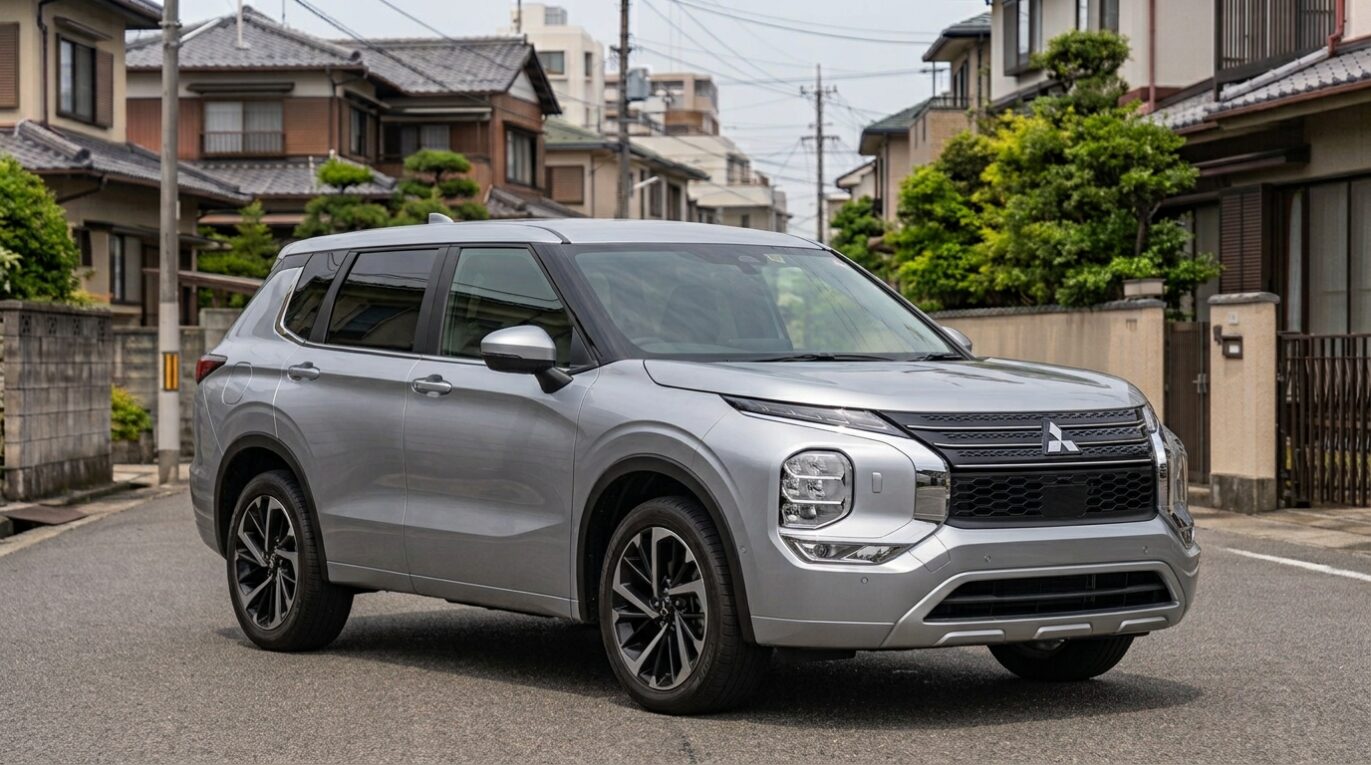
The Mitsubishi Outlander has never been the first SUV that comes to mind when Kenyans start talking about Japanese imports. Toyota tends to dominate that conversation, followed by Mazda, Nissan and Subaru. But something interesting has been happening with the new-generation Mitsubishi Outlander, particularly the models arriving from Japan from around 2022 onwards.
The newer Outlander looks nothing like the somewhat conservative SUV many Kenyan buyers remember. It is larger, more imposing and considerably more sophisticated inside, while retaining the practical qualities that have made the Outlander appealing to families. More importantly, the Japanese-market version that Kenyan importers are increasingly bringing in is the GN0W-generation Outlander PHEV, introduced from 2021/2022. Mitsubishi’s own specifications confirm that the Japanese GN0W is a plug-in hybrid and uses a 2.4-litre petrol engine, two electric motors and four-wheel drive.
That makes this a very different proposition from the older Outlanders that have been familiar on Kenyan roads for years.
The New Outlander Finally Looks Like a Serious SUV
The first thing you notice is the size. The current Japanese-market Outlander is about 4.71 metres long, 1.86 metres wide and up to 1.745 metres tall, with a 2.705-metre wheelbase. Depending on the version, ground clearance is around 195–200 mm.
That gives it a much more substantial presence than the previous generation. The upright front end, split headlamps and large grille give it the sort of road presence buyers normally associate with considerably more expensive SUVs.
It also makes sense on Kenyan roads. The Outlander is wide enough to feel like a proper family SUV without becoming unnecessarily enormous, while the ground clearance provides useful breathing room over speed bumps, rough estate roads and uneven sections. It is not a Land Cruiser Prado and shouldn’t be treated like one, but it is certainly more than a soft city crossover.
The design is probably one of the biggest reasons the newer Outlander has started attracting attention. It looks expensive without being excessively flashy.
There is an important distinction when shopping for this generation. The Japanese GN0W Outlander is a PHEV, rather than simply a conventional petrol SUV. Mitsubishi confirms that the Japanese GN0W range was offered exclusively as a plug-in hybrid, with no conventional petrol or diesel version in that market.
Its system combines a 2.359-litre four-cylinder MIVEC petrol engine with electric motors on the front and rear axles. The engine produces 98 kW and 195 Nm, while the electric motors produce up to 85 kW at the front and 100 kW at the rear. The battery is a 20 kWh lithium-ion unit in the earlier specification, with later versions receiving a 22.7 kWh battery.
This is quite different from simply putting a small electric motor alongside a petrol engine to improve fuel consumption. The Outlander PHEV can operate as an electric vehicle for a meaningful distance before relying more heavily on its petrol engine.
Mitsubishi’s current Japanese specifications quote an EV driving range of roughly 100 km under the WLTC test cycle, depending on version and specification. Earlier GN0W specifications were around 83–87 km. That makes the Outlander particularly interesting for someone who can charge at home or at work.
But Don’t Buy It Just Because It Says Hybrid
This is probably the most important warning for a Kenyan buyer. A plug-in hybrid only delivers its greatest fuel-saving potential when the battery is actually charged.
If you never plug the vehicle in and simply drive it like a conventional hybrid, you’re carrying around a large battery and electric drivetrain without taking full advantage of what makes the PHEV different. The vehicle can still operate as a hybrid, but the ownership equation changes.
For someone who drives relatively short distances around Nairobi and can charge overnight at home, the Outlander PHEV makes a lot more sense. Your daily journeys could potentially be completed largely on electric power, with the petrol engine becoming more important on longer trips.
For someone who lives in a place where charging is difficult and regularly drives hundreds of kilometres between towns, the calculation is less straightforward. This is one of those cars where your lifestyle matters almost as much as the specification.
How Does It Drive?
The newer Outlander feels considerably more refined than its predecessors. The electric motors provide immediate torque, so acceleration from low speeds is smooth and effortless. Instead of waiting for a conventional automatic transmission to select the right gear or for the petrol engine to build revs, the electric motors can respond almost instantly. That makes the car particularly pleasant in traffic.
The 4WD system is another major strength. The PHEV uses an electric motor at each axle, giving it all-wheel-drive capability without the same conventional mechanical arrangement found in many petrol 4WD SUVs. Mitsubishi also uses its Super-All Wheel Control (S-AWC) system to manage traction and vehicle behaviour. On wet roads, loose surfaces and rough sections, that can provide useful additional confidence.
But don’t confuse sophisticated all-wheel drive with permission to attack every muddy road you find. The Outlander remains a relatively heavy family crossover, and its low-profile tyres on some higher grades are not exactly designed for serious off-road punishment.
It Is a Proper Family SUV
One of the Outlander’s strongest arguments in Kenya is practicality. The newer model is available with five- and seven-seat configurations, depending on specification. Mitsubishi’s Japanese specifications list both arrangements, although the seating configuration can affect interior dimensions and vehicle weight.
The first two rows are where the Outlander is at its best. There is good space for adults, the cabin feels considerably more upscale than older Outlanders, and the larger body gives the vehicle a genuinely comfortable family-car character.
The third row, where fitted, should be viewed more realistically. Like many compact and midsize SUVs with occasional seven-seat capability, it is better suited to children or shorter journeys than to carrying seven adults across the country.
For a family of five, however, the Outlander can make a lot of sense. It has enough space for everyday family life without becoming as large and cumbersome as some traditional seven-seat SUVs.
What About Fuel Consumption?
This is where the Outlander PHEV can either be brilliant or merely average, depending on how you use it. Mitsubishi’s Japanese specifications quote WLTC hybrid fuel economy in the region of 16–18 km/L, depending on the version, while the plug-in electric range is roughly 80–100 km depending on model and testing specification. But don’t take those figures as a promise that every Kenyan owner will achieve them.
A PHEV’s real-world fuel consumption is heavily influenced by charging frequency. Someone who charges every night and mostly drives within the electric range can use remarkably little petrol. Someone who rarely charges and drives long distances may see a much less impressive result.
That is actually one of the biggest differences between buying a normal hybrid and buying a plug-in hybrid. With a normal hybrid, you simply fuel it and drive. With the Outlander PHEV, charging becomes part of the ownership routine. For the right owner, that’s a major advantage. For the wrong owner, it can be an unnecessary complication.
The Interior Is a Big Step Forward
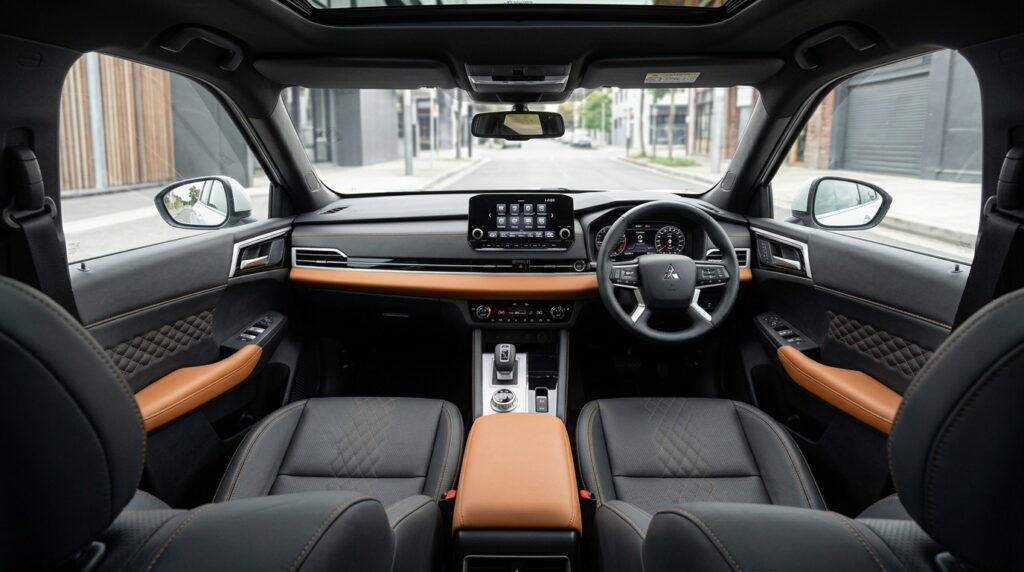
This is probably the area where the newer Outlander has changed most dramatically. The cabin is cleaner and more sophisticated, with a much more premium appearance than the previous generation. Higher grades can include features such as leather upholstery, large infotainment displays, premium audio and extensive driver-assistance equipment. Mitsubishi clearly wanted the Outlander to compete higher up the market, and it shows.
The important thing, however, is not to assume every imported Outlander has identical equipment. Japanese specifications vary by grade, and vehicles arriving in Kenya can range from relatively modest versions to highly equipped P and Black Edition models. Check the exact grade rather than buying based on photographs or a dealer’s description.
What About Reliability and Maintenance?
This is where I would be more cautious than I would be with a conventional Toyota. The Outlander itself isn’t an inherently unreliable vehicle, and Mitsubishi has considerable experience with plug-in hybrid technology. The GN0W PHEV also represents a major development of the company’s earlier PHEV system, with Mitsubishi stating that the motors, battery and control systems were substantially upgraded.
But the PHEV system is more complex than a conventional petrol engine. There is a petrol engine, two electric motors, a high-voltage battery, charging equipment and sophisticated electronic control systems. That doesn’t mean these components will fail regularly; it means that when something outside routine servicing does go wrong, you want a technician who actually understands the system. This is probably the biggest consideration for Kenyan buyers.
The availability of Mitsubishi parts and mechanics has improved, but the specialist knowledge required for a modern PHEV is not yet as widespread as Toyota hybrid expertise. So before buying one, find out where you will service it. That question is just as important as asking how much the car costs.
Is It Worth Buying in Kenya?
For the right buyer, yes, very much so. The newer Mitsubishi Outlander is one of the more interesting alternatives to the usual Toyota-dominated SUV choices. It looks modern, has genuine family practicality, offers four-wheel drive and combines a 2.4-litre petrol engine with an advanced plug-in hybrid system. But it isn’t a car I’d recommend blindly to everyone.
If you want a straightforward SUV that any competent mechanic can diagnose and repair almost anywhere, a conventional Toyota may still be the easier ownership proposition. If you’re comfortable with newer technology, have reliable access to charging and want to reduce petrol consumption without giving up the ability to travel long distances, the Outlander PHEV becomes much more compelling. The difference is less about whether the car is good and more about whether the car fits your lifestyle.
If you’re comparing the Outlander with other family SUVs, our Best Family Cars in Kenya for Long-Distance Travel guide looks at the vehicles that make the most sense when comfort, reliability and road-trip practicality matter.
At Iko Gari, we don’t believe every Kenyan buyer needs a Toyota. Sometimes the better choice is the vehicle that offers something different while still making sense for the roads, budget and lifestyle of the person buying it. The newer Outlander is one of those cars worth looking at properly before making that decision.