


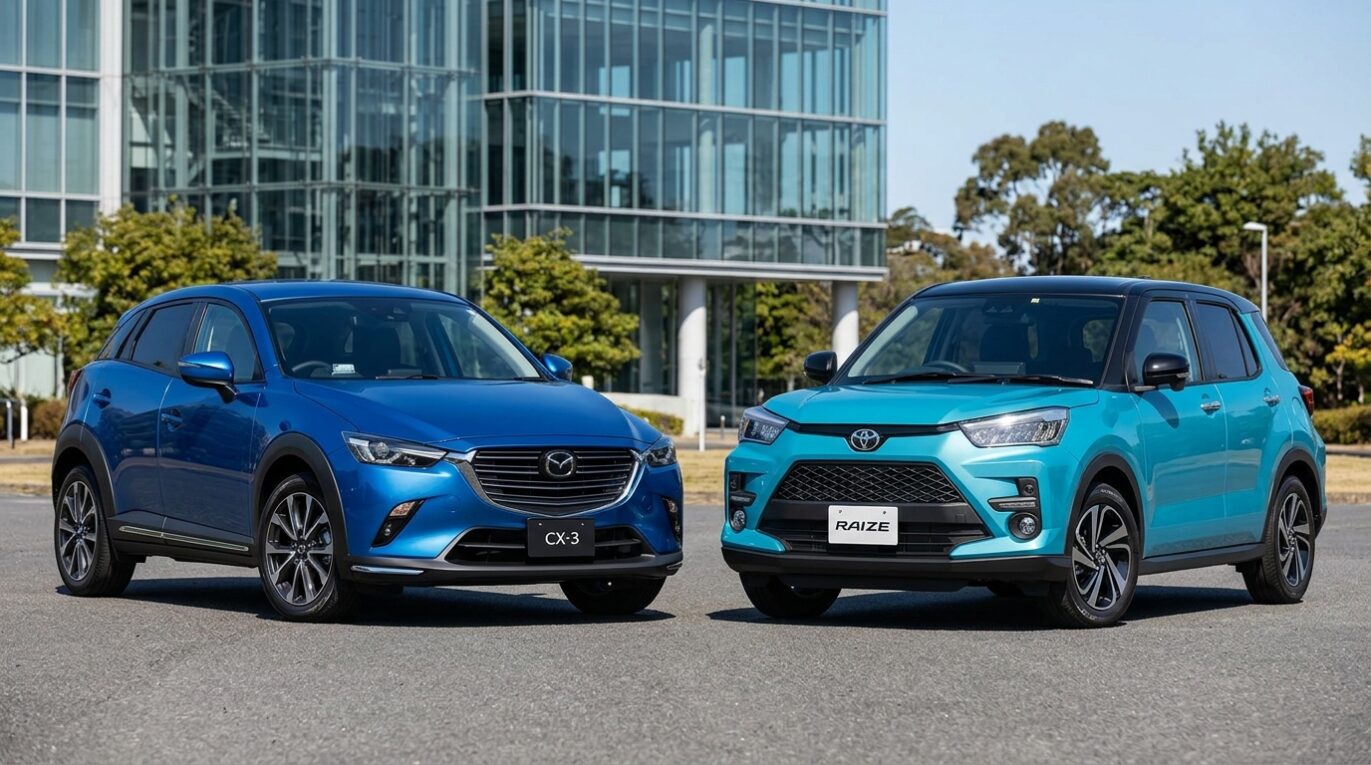
There is a particular kind of car buyer who wants an SUV but doesn’t actually want a big SUV. You want the higher driving position, some extra ground clearance and the practicality of five doors, but you also don’t want to spend your life feeding a large engine or squeezing a bulky vehicle through Nairobi traffic.
That is where the Mazda CX-3 and Toyota Raize become interesting. They are both compact crossovers, but they approach the job quite differently. The Raize is smaller, lighter and strongly focused on efficiency and urban practicality, while the CX-3 feels more substantial, more mature inside and more engaging to drive.
For a Kenyan buyer deciding between the two, the answer isn’t simply about which badge is more popular. It comes down to what you value most: fuel economy, driving feel, space, ground clearance, maintenance, or the overall ownership experience.
The Toyota Raize was designed around the idea of making an SUV that remains easy to live with in crowded urban environments. It is just under four metres long and 1.695 metres wide, with a 2.525-metre wheelbase. Toyota also gives it about 185 mm of ground clearance, which is useful when dealing with speed bumps, rough sections and uneven roads.
The Mazda CX-3 is physically larger. Depending on specification, it is around 4.275 metres long and about 1.765 metres wide, with a 2.570-metre wheelbase. Its ground clearance is considerably lower, around 155–160 mm on many versions.
That difference is noticeable on Kenyan roads. The Raize has the more convincing SUV stance when you encounter a steep speed bump or rough estate road, while the CX-3 sits closer to the ground and feels more like a hatchback that has been given crossover styling. Neither is an off-road vehicle, but the Raize gives you more margin when the tarmac disappears.
The Engines Tell Two Different Stories
This is probably the biggest mechanical difference between the two. Japanese-market Toyota Raizes were initially offered with a 1.0-litre three-cylinder turbo engine producing about 98 hp and 140 Nm, paired with a CVT. Later versions also received a naturally aspirated 1.2-litre engine, while Toyota introduced a hybrid version in Japan as well. The exact engine therefore needs to be confirmed from the chassis and specification rather than assuming every Raize has the same powertrain.
The CX-3 found in the Kenyan used-import market is commonly seen with Mazda’s 2.0-litre Skyactiv-G petrol engine, although 1.5-litre diesel versions also exist. Mazda’s Japanese specifications show the CX-3 being offered with both petrol and diesel engines, as well as front-wheel drive and four-wheel drive depending on grade.
On paper, the Raize’s small turbo engine looks almost too small for an SUV. In practice, its low weight makes it surprisingly capable for city driving. The turbocharged 1.0-litre produces its maximum 140 Nm of torque from 2,400 to 4,000 rpm, giving it enough punch for normal urban and highway driving.
The CX-3’s 2.0-litre petrol engine takes a different approach. It doesn’t rely on turbocharging and instead uses a larger naturally aspirated engine with linear power delivery. It feels more substantial when accelerating, particularly when overtaking or carrying several passengers.
If you like a car that responds naturally and feels composed at highway speeds, the Mazda has the advantage. If your priority is a light, economical vehicle for everyday urban use, the Raize makes a stronger case.
Fuel Economy Favors the Raize
This is where the Toyota becomes particularly attractive. Official Japanese figures for the Raize vary significantly depending on engine, drivetrain and testing cycle. For example, a 1.2-litre front-wheel-drive version is listed at 20.7 km/L under the WLTC test, while the earlier 1.0-litre turbo models were rated at around 17.4 km/L under the same cycle.
Those figures should not be confused with what you will necessarily achieve in Nairobi traffic. Real-world fuel consumption is affected by congestion, driving style, air-conditioning use, tyre pressure and vehicle condition.
The CX-3’s 2.0-litre petrol engine will generally use more fuel than the smaller Raize engine, although real-world results vary considerably. Kenyan road tests and owner experiences put many 2.0-litre CX-3s around the low-double-digit kilometres-per-litre range depending on conditions. If fuel expenditure is one of your biggest concerns, particularly if you drive every day in heavy traffic, the Raize is the easier choice.
The Mazda Feels More Like a Driver’s Car
Where the CX-3 starts to claw back ground is behind the steering wheel. Mazda has traditionally placed considerable emphasis on driving feel, and the CX-3 is noticeably more engaging than many small crossovers. The steering feels direct, the body doesn’t lean excessively through corners and the 2.0-litre engine gives the driver more confidence when joining a highway or overtaking.
The Raize is perfectly pleasant to drive, but its strengths are different. Its compact dimensions and tight turning circle make it exceptionally easy to manoeuvre around town, while the light body contributes to its efficiency. Toyota’s Japanese specification lists a turning radius of about 4.9–5.0 metres depending on version.
So if your idea of a good car is one that disappears into the background and simply makes daily driving easy, the Raize is excellent. If you actually enjoy driving and want a little more character from the car, the CX-3 is more satisfying.
What About Interior Quality and Comfort?
This is one area where the Mazda makes a strong impression. The CX-3’s cabin feels more mature than its size suggests. The driving position is good, materials are generally well put together and the interior has a more premium feel than you might expect from a small crossover. Mazda’s approach is less about loading the dashboard with gadgets and more about creating a cockpit that feels focused on the driver.
The Raize counters with clever use of space. Despite its small exterior dimensions, Toyota designed the cabin to make reasonable use of the available footprint, and its relatively tall body gives passengers a useful amount of headroom.
Neither is a particularly spacious family SUV, though. The CX-3’s rear seat is not especially generous for tall adults, while the Raize’s compact dimensions also mean you shouldn’t expect large-SUV levels of rear-seat space. For a couple or small family, both can work well. If you regularly carry four adults on long journeys, I’d be more inclined to look at a larger crossover.
Which One Is Better for Kenyan Roads?
This requires a little honesty about what we mean by “Kenyan roads.” Neither the CX-3 nor Raize is designed to replace a Prado when you leave the tarmac. These are compact crossovers, not serious off-roaders. But the Raize does have an advantage in ground clearance. Its approximately 185 mm clearance gives it more breathing room over speed bumps and rough surfaces than the CX-3’s roughly 155–160 mm.
That doesn’t mean the CX-3 is unsuitable for Kenya, far from it. It is perfectly comfortable for normal urban and highway use, and its low centre of gravity contributes to its stable handling. You simply need to be more conscious of deep potholes, steep ramps and badly damaged roads. If your regular route includes rough estate roads or frequent upcountry travel on uneven surfaces, the Raize has the practical advantage.
Which One Offers Better Value?
This is where I wouldn’t give you the usual “Toyota wins because Toyota” answer. The Raize offers better value for the buyer who prioritises economy, ground clearance, compact dimensions and straightforward everyday ownership. It is particularly attractive for someone driving mainly in Nairobi or another busy urban environment who wants an SUV-like driving position without SUV-like running costs.
The CX-3 offers better value for someone who wants a more refined driving experience, stronger performance and a more premium-feeling cabin. It also feels more substantial at highway speeds, which matters if long-distance driving is part of your routine.
The price difference between individual used examples can also change the calculation completely. A clean, well-maintained CX-3 with a good history may be a better purchase than an overpriced Raize simply because the latter has a Toyota badge. Condition comes first.
If the Toyota Raize is on your shortlist, our Toyota Raize Review: Is It Worth Buying in Kenya? takes a closer look at its fuel economy, practicality, reliability and the compromises you should understand before buying one. At Iko Gari, we don’t think the best car is necessarily the one with the most popular badge. It is the one that fits your roads, your budget, your driving habits and the kind of ownership experience you actually want.