


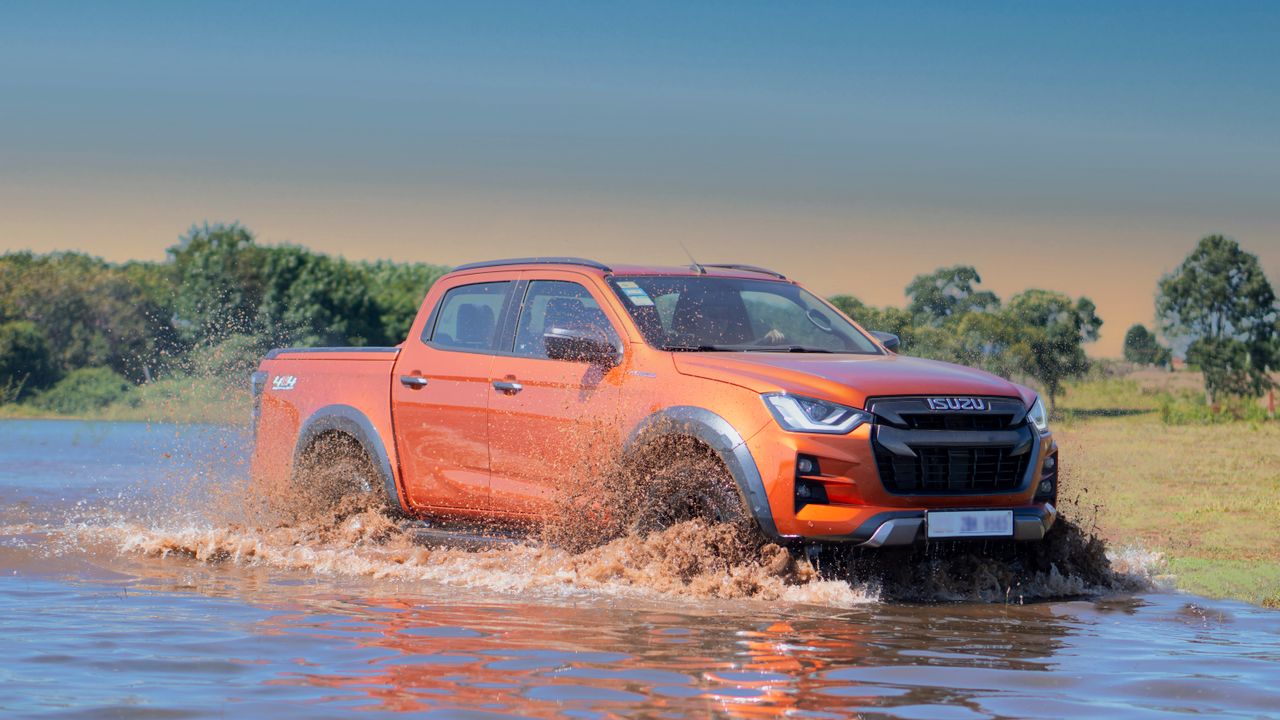
There is a reason why Isuzu D-Max has become such a familiar sight on Kenyan roads. It isn’t trying to be a luxury SUV that happens to have a pickup bed. The D-Max was built around a simpler idea, carry people and cargo, handle difficult roads and keep working when the vehicle is being used for business rather than weekend appearances.
That makes it particularly relevant in Kenya where pickups serve very different purposes. One D-Max might spend its week carrying farm produce, another might be transporting equipment between construction sites, while a third belongs to a family that simply wants a capable vehicle for long-distance travel and occasional off-road trips.
The current-generation D-Max is also considerably more sophisticated than the workhorse image suggests. Isuzu East Africa currently offers the Double Cab with both 1.9-litre and 3.0-litre turbo-diesel engines, six-speed manual or automatic transmissions on selected versions, and 4×4 configurations. The flagship 3.0-litre produces 190 hp and 450 Nm, while the 1.9-litre produces 110 kW and 350 Nm. So, is the D-Max actually a good buy for a Kenyan driver?
The D-Max’s biggest strength is also the reason you shouldn’t buy one simply because pickups look tough. If you regularly carry heavy equipment, travel on rough roads, operate a farm or construction business, or need a vehicle that can work during the week and serve the family at weekends, the D-Max makes a strong case. Its ladder-frame construction, diesel engines, available 4×4 system and substantial payload and towing capabilities are designed around exactly that kind of use.
The current Double Cab range is available with a 1.9-litre engine producing 350 Nm and a 3.0-litre producing 450 Nm. The 3.0-litre 4×4 has a braked towing capacity of up to 3.5 tonnes, according to Isuzu East Africa, while the 1.9-litre versions are rated lower.
That difference matters. If your D-Max is primarily a family vehicle that occasionally carries luggage, the 1.9-litre may be enough. If you’re regularly pulling trailers, carrying serious loads or travelling through demanding terrain, the 3.0-litre is much easier to justify.
It Is Surprisingly Civilised on the Road
Older pickups had a reputation for being uncomfortable, noisy and tiring to drive when unloaded. The D-Max has moved considerably beyond that.
The current model’s six-speed automatic is particularly useful if you’re using the pickup as a daily vehicle. It takes some of the effort out of Nairobi traffic while still giving the driver access to the torque the diesel engine produces. The six-speed manual remains available on selected versions for buyers who prefer more direct control and potentially simpler operation.
The D-Max is still a pickup, though. It doesn’t ride like a Toyota Premio or Mazda CX-5, especially when the rear bed is empty. The rear leaf-spring suspension is designed to carry loads, and you can feel that purpose when driving over rough roads without much weight in the back.
Put a decent load over the rear axle and the character changes considerably. That’s not a flaw. It’s simply something buyers need to understand before deciding that a pickup should behave like a family crossover.
The 4×4 System Is Where the D-Max Earns Its Reputation
For Kenyan buyers who regularly leave the tarmac, this is one of the D-Max’s strongest selling points. The 4×4 versions feature Isuzu’s Terrain Command system, allowing the driver to select the appropriate drivetrain mode for changing conditions. The current D-Max also offers a rear differential lock on applicable 4×4 models, while Isuzu quotes an 800 mm wading depth for the D-Max.
Those specifications are useful, but they shouldn’t encourage overconfidence. An 800 mm wading capability doesn’t mean you should drive into every flooded road you encounter. Water depth can change unexpectedly, and the condition of the road underneath may be impossible to see.
For farms, construction sites, muddy roads and rough upcountry routes, however, the D-Max has genuine capability rather than merely aggressive-looking bodywork.
The Cabin Is No Longer Basic
This is another area where the newer D-Max deserves credit. Depending on the grade, you can get features including a 9-inch touchscreen with wireless Apple CarPlay and Android Auto, keyless entry, push-button start, reversing camera, automatic high beams and blind-spot monitoring. Higher specifications also offer additional safety and convenience equipment.
The cabin therefore works reasonably well as a family vehicle, particularly in the higher grades. But there is still a clear difference between the D-Max and a luxury SUV. Hard-wearing materials and a practical layout remain part of its character, and that’s probably appropriate for a vehicle that may spend Monday morning on a construction site and Saturday afternoon carrying the family. The Double Cab also seats five, making it considerably more versatile than a single-cab work truck.
Safety Has Improved Significantly
The modern D-Max is considerably better equipped than older pickups when it comes to safety. Depending on specification, the current range includes multiple airbags, electronic stability-related systems, rear parking assistance and, on higher grades, technologies such as blind-spot monitoring, automatic high beam and other driver-assistance features. The 3.0-litre TFS 40 Double Cab, for example, is listed with seven airbags and front and rear parking assistance by Isuzu East Africa.
The important point for a buyer is that equipment varies by grade. Don’t assume that every D-Max you see has the same safety features simply because it is the same model. If safety technology is important to you, check the exact specification of the vehicle you’re buying.
What About Fuel Consumption?
This is probably the biggest question for anyone considering a diesel pickup. The D-Max’s diesel engines are designed around torque and efficiency, but you shouldn’t expect small-car fuel consumption. Weight, 4×4 use, tyre choice, driving style, payload and traffic all make a noticeable difference.
A D-Max carrying a heavy load on rough roads will naturally consume more fuel than an unloaded one cruising on a highway. The same applies when you spend much of your time in stop-start urban traffic.
The 1.9-litre has the advantage on paper because of its smaller displacement, while the 3.0-litre gives you considerably more performance. If you don’t need the additional power, there is little reason to buy the bigger engine simply for the sake of having it.
For many buyers, the sensible calculation is not “which engine uses the least fuel?” but “which engine gives me enough power for the work I actually do without paying for capability I rarely use?”
Maintenance Is One of Its Strong Points in Kenya
This is where the D-Max has an advantage that isn’t captured by a specification sheet. Isuzu has a long-established commercial vehicle presence in Kenya, and its dealer and service network is built around supporting vehicles that are expected to work for a living. Isuzu East Africa also provides parts and service support through its local network. That matters when you’re running a commercial vehicle. Downtime isn’t simply inconvenient; it can cost a business money.
The D-Max isn’t maintenance-free, of course. Diesel engines need proper servicing, 4×4 components need attention, suspension components eventually wear out and a working pickup can be harder on tyres and brakes than a normal sedan. But the availability of local technical support is one of the reasons the D-Max makes sense for Kenyan commercial users.
The Price Is Not Small-Car Money
The biggest drawback for some buyers is the initial price. Isuzu East Africa currently lists the D-Max Double Cab 1.9 4×4 at about KSh 6.95 million for the manual and KSh 7.2 million for the automatic, while the 3.0-litre TFS 40 4×4 Double Cab is listed at approximately KSh 9 million. Prices and specifications can change, so these figures are best treated as current official reference points rather than permanent market prices. That puts the new D-Max into serious-money territory.
But the comparison shouldn’t simply be with the price of a used Japanese pickup. A new locally supported vehicle comes with a different ownership proposition, including warranty and manufacturer-backed service support.
For a business, the calculation can therefore be different from that of a private buyer. A vehicle that remains productive and has predictable support can justify a higher purchase price if downtime is expensive.
So, should you buy the D-Max? If you need a pickup because you actually have pickup work to do, the D-Max is one of the strongest options available in Kenya. Its combination of diesel torque, 4×4 capability, useful towing capacity, established local support and increasingly sophisticated cabin makes it much more than a basic work truck. The 3.0-litre is particularly convincing if you regularly carry heavy loads or tow, while the 1.9-litre makes more sense for buyers who want D-Max capability without stepping up to the larger engine.
But if you’re mainly driving around Nairobi with nothing in the cargo bed, you should ask yourself whether you really need a pickup. A crossover or SUV will generally be easier to park, more comfortable when unloaded and potentially cheaper to run. That’s the D-Max’s defining characteristic: it is at its best when you use what it was built to do.
At Iko Gari, we don’t think every buyer needs a pickup. But for the person who genuinely needs one, the D-Max makes a strong argument for choosing a vehicle designed to work rather than one that merely looks like it can.