

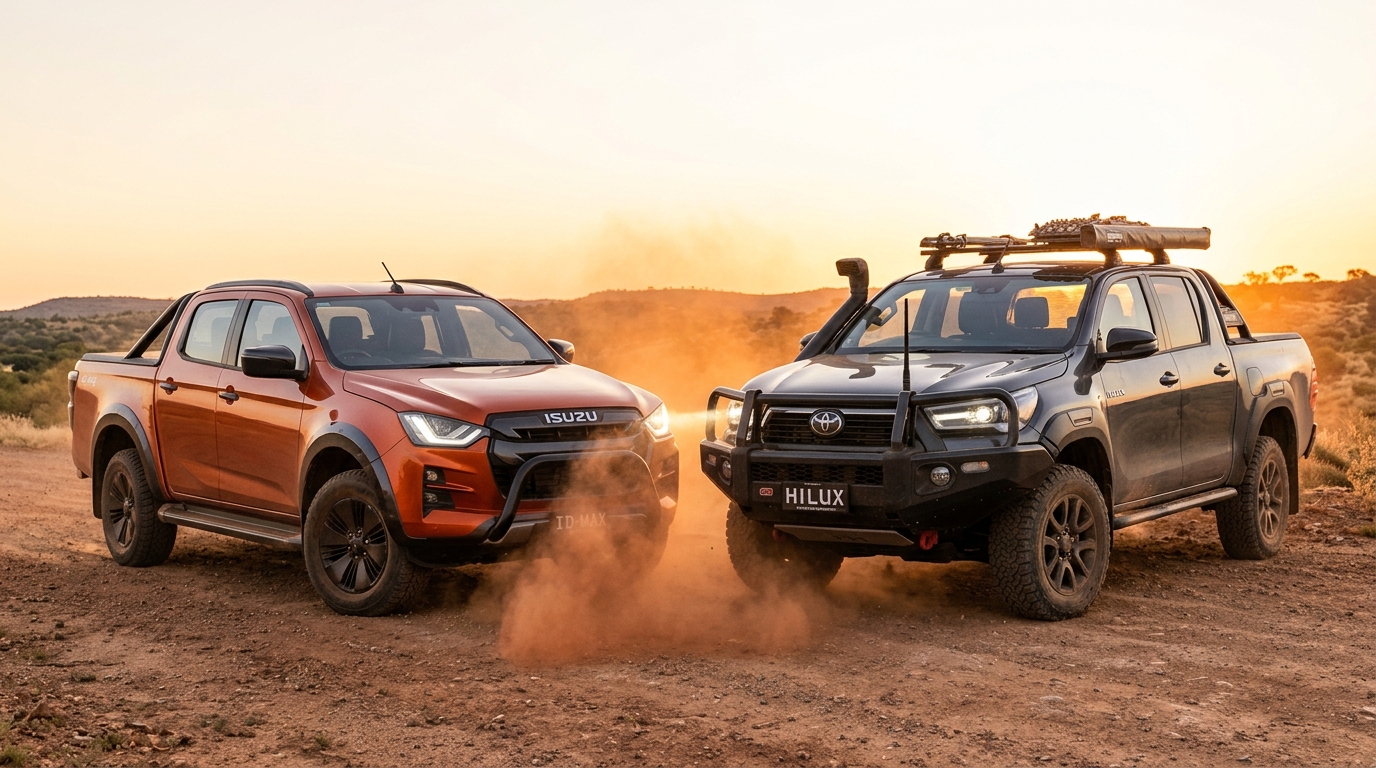
If you mention pickups in Kenya, the conversation usually gets to the Toyota Hilux and Isuzu D-Max pretty quickly. Both have earned reputations as hardworking pickups, both are widely used by businesses and private owners, and both are designed to cope with the kind of roads and workloads that can expose a weaker vehicle very quickly.
But they are not identical. The Hilux has the stronger brand presence and a huge following in Kenya, while the D-Max has built its reputation around commercial use, durability and straightforward workhorse ability. So if you have the money for either one, which gives you the better deal? The answer depends largely on how you intend to use the pickup.
The Hilux Has the Stronger Market Reputation
The Toyota Hilux has an enormous advantage in Kenya, that is familiarity. There are Hiluxes everywhere, from private farms to construction sites, government fleets and long-distance businesses. That means parts, mechanics and knowledge of the vehicle are generally easy to find. Toyota Kenya currently offers the Hilux in several configurations, including single-cab, extra-cab and double-cab versions, with different engine and drivetrain options.
The D-Max has a similarly established commercial presence, and Isuzu East Africa has been supporting the Kenyan market for decades. Its current D-Max range includes single-cab, extended-cab and double-cab models, with 1.9-litre and 3.0-litre diesel options.
So this isn’t really a comparison between a well-supported pickup and an obscure alternative. Both are serious commercial vehicles with established support in Kenya.

The difference is that the Hilux has a stronger image among private buyers, while the D-Max often feels like the pickup chosen by people who are more concerned with getting work done than with owning the most fashionable badge.
The Engines Tell an Interesting Story
The current D-Max gives Kenyan buyers a choice between a 1.9-litre turbo-diesel producing 350 Nm and a 3.0-litre diesel producing 450 Nm. The flagship 3.0-litre engine develops 190 hp and is available with four-wheel drive and automatic transmission on selected versions.
The Hilux range is more varied depending on market and specification. Toyota Kenya’s current Hilux models include diesel powertrains such as the 2.4-litre and 2.8-litre engines, with the 2.8-litre offering substantially more power and torque than the smaller engine.
For a buyer who regularly carries heavy loads or tows, the larger engines in both ranges make more sense. The D-Max 3.0’s 450 Nm gives it plenty of low-speed pulling power, while the Hilux 2.8 has a similarly strong reputation for combining torque with highway performance.
If the pickup is mainly going to carry light loads and serve as your everyday vehicle, the smaller engines can make more financial sense. This is one area where I wouldn’t choose purely on horsepower. Think about what you’re actually going to carry and tow.
Which One Handles Rough Roads Better?
Both are built for conditions that would make a normal sedan uncomfortable. The D-Max has around 800 mm of claimed wading depth on applicable versions, while its 4×4 system and rear differential lock are designed to improve traction on difficult surfaces.
The Hilux is similarly capable, particularly in 4×4 form. Depending on specification, it offers features such as low-range gearing and electronic systems designed to manage traction on different surfaces.
In everyday Kenyan conditions, however, the difference isn’t likely to be dramatic. A well-equipped 4×4 D-Max and 4×4 Hilux can both handle muddy roads, rough tracks and challenging rural terrain far better than a normal crossover.
The bigger question is whether you actually need 4WD. If your pickup spends almost all its time on tarmac, paying extra for 4WD may not make financial sense. If you’re travelling to farms, construction sites or remote areas where road conditions can change dramatically, it becomes much easier to justify.
The D-Max Feels Like a Work Vehicle
This is where the personalities of the two pickups start to separate. The D-Max has a very commercial-vehicle feel. Even in Double Cab form, you can tell that Isuzu designed it around people who expect the vehicle to work. The 3.0-litre engine’s strong torque delivery suits carrying loads, while the chassis and suspension are built around durability.
The Hilux can do exactly the same work, but Toyota has pushed the newer models further towards being comfortable enough for private use. That makes the Hilux slightly easier to recommend as a dual-purpose vehicle, something you use for business during the week and take the family out in at the weekend.
The D-Max isn’t uncomfortable, but its strengths are more obvious when there is actually something in the cargo bed.
What About Comfort?
The gap between modern pickups and older workhorses is much smaller than it used to be. A current Hilux Double Cab can be a surprisingly comfortable daily driver, with a reasonably refined cabin, modern infotainment and available driver-assistance features depending on specification. The D-Max has also moved in this direction, with higher grades offering features such as a 9-inch touchscreen, wireless Apple CarPlay and Android Auto, keyless entry and various driver-assistance systems.
If comfort is your number-one priority, neither pickup should be your first choice. A Mazda CX-5 or Toyota RAV4 will generally provide a more comfortable ride because their suspension isn’t designed around carrying heavy loads. That’s the compromise with pickups.
An empty pickup can feel firm and sometimes bouncy over rough surfaces. Put a meaningful load in the back and the suspension settles down and the vehicle’s character changes.
Which Has Better Fuel Economy?
There isn’t a simple winner here because engine size, transmission, drivetrain, payload and driving conditions all have a major influence.
The D-Max’s 1.9-litre diesel has an obvious advantage in displacement over the 3.0-litre version, while the Hilux’s smaller diesel engine similarly offers a more economical proposition than its larger alternatives.
But if you’re comparing two vehicles that are both carrying heavy loads, driving in 4×4 mode or spending hours in Nairobi traffic, the theoretical difference between engine sizes can become less important than how they’re actually being used.
For a business, I’d therefore calculate fuel consumption based on cost per kilometre under your real workload, rather than relying entirely on manufacturer’s laboratory figures.
Maintenance and Parts Are Important in Kenya
This is one of the biggest reasons the Hilux is so difficult to beat locally. Toyota has an enormous parts and repair ecosystem in Kenya. Even outside official dealerships, you’ll find mechanics who have worked on Hiluxes for years. That can make ownership easier, particularly when you’re far from Nairobi.
The D-Max also has a major advantage here because Isuzu East Africa has a well-established local network and is heavily involved in commercial vehicles. Isuzu’s Kenyan operation provides sales, parts and after-sales support for its truck and pickup range.
For someone operating a commercial fleet, that support can be just as important as the vehicle itself. A pickup sitting in a workshop isn’t earning money. I would give the Hilux a slight edge for sheer parts familiarity and resale-market support, but the D-Max is certainly not difficult to support in Kenya.
So, Which One Is Stronger?
This is the part where the usual Toyota-versus-everything-else argument becomes too simplistic. The D-Max is an extremely capable pickup, particularly in 3.0-litre 4×4 form. Its strong torque, commercial-vehicle heritage and local Isuzu support make it a very sensible choice for someone who genuinely works the vehicle.
The Hilux, however, offers a more rounded ownership proposition. It combines serious working ability with better market acceptance among private buyers, strong resale value and an enormous support ecosystem.
So if you’re buying primarily for business and heavy-duty work, I’d take a very serious look at the D-Max. You may get much of the capability you need without paying purely for Toyota’s market premium.
If you’re buying a pickup that will work during the week, carry the family on weekends and eventually be sold, the Hilux is probably the safer all-round choice.
To conclude, the Toyota Hilux and Isuzu D-Max are both excellent pickups for Kenya, but they appeal to slightly different buyers. The Hilux has the advantage in brand recognition, resale value and the sheer depth of Toyota’s local ecosystem. It is the easier choice for someone who wants a pickup that can work hard but still feels comfortable as a private family vehicle.
The D-Max makes a compelling argument for buyers who care more about capability than badge prestige. Its 3.0-litre diesel produces 450 Nm, the 4×4 versions are genuinely capable and Isuzu’s commercial-vehicle experience is a major advantage for business users.
If you’re buying with your head, compare the exact engine, drivetrain, specification, price and condition rather than simply choosing the more popular badge. If you’re buying for resale and broad market appeal, the Hilux has the advantage. If you’re buying a machine to work, the D-Max deserves to be taken very seriously. And if you’re lucky enough to find a clean unit of either, you probably won’t regret the choice.