

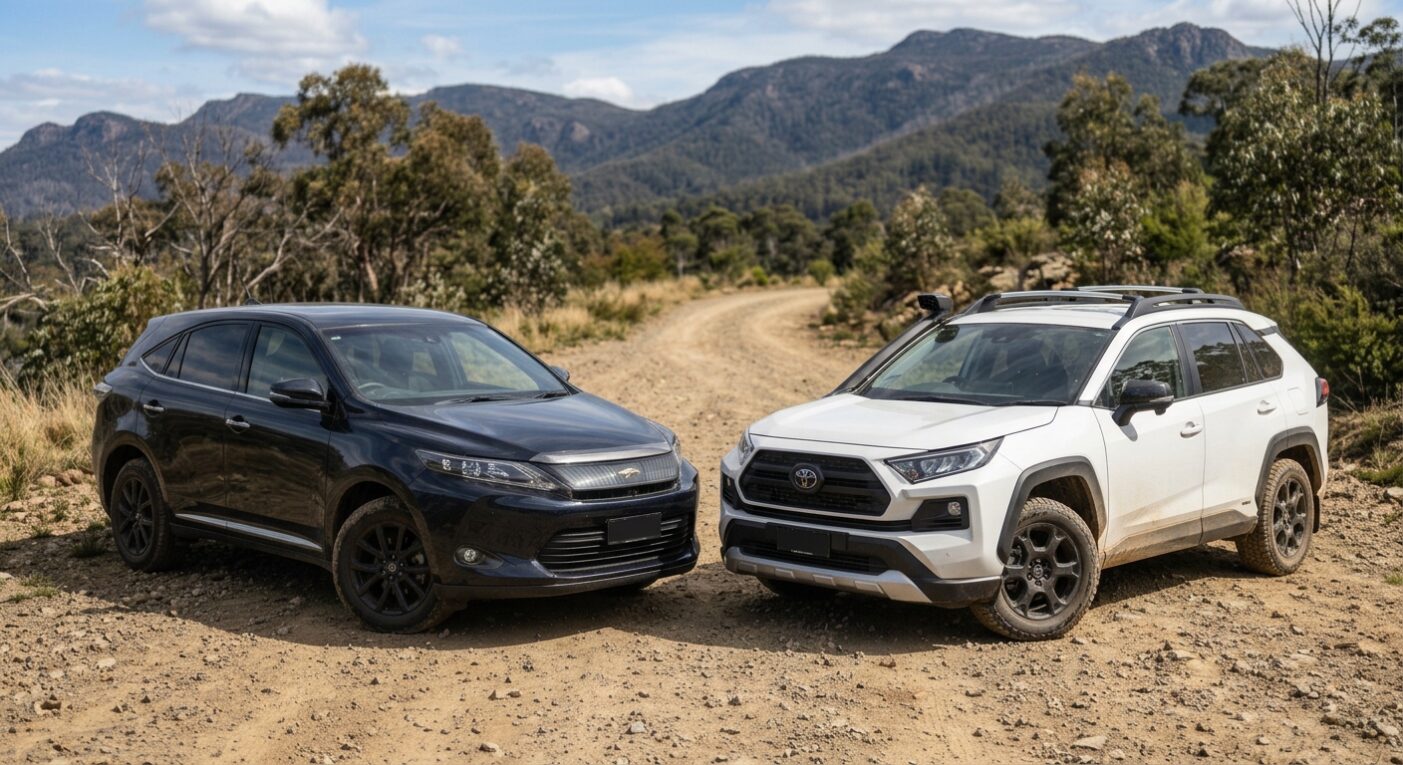
The Toyota Harrier and Toyota RAV4 have always attracted slightly different buyers, but in Kenya they increasingly find themselves competing for the same money. Both are Japanese SUVs with strong Toyota reliability, good road manners and plenty of appeal in the used-car market. The difference is that the RAV4 is built more around practicality and versatility, while the Harrier has traditionally leaned towards comfort, refinement and a more premium experience.
That distinction becomes even more interesting with the newer RAV4 now becoming increasingly popular in Kenya. A buyer with roughly the same budget can find themselves choosing between a fifth-generation RAV4 and a newer-shape Harrier, and the better choice depends less on the badge than on what you expect from the car.
The Harrier Feels More Premium
The Harrier wins the first impression contest quite easily. Its cabin is quieter and more refined, the seats tend to feel more substantial and the overall interior has a more upmarket character. The current fourth-generation Harrier, introduced in Japan in 2020, was developed on Toyota’s GA-K platform, the same broader platform family used by the fifth-generation RAV4. That gives the two cars more in common mechanically than their different personalities might suggest.
The RAV4, meanwhile, feels more practical. Its interior is designed to withstand everyday use, and the controls and storage areas are generally straightforward. It doesn’t try as hard to create a luxury atmosphere.
For someone spending several hours commuting around Nairobi, the Harrier’s quieter and more relaxed character can be genuinely appealing. If you’re more concerned about carrying luggage, navigating rougher roads and getting the most practical SUV for your money, the RAV4 starts making a stronger case.
The RAV4 Is the More Versatile SUV
This is probably the biggest difference between them. The RAV4 has a more upright, rugged design and useful ground clearance, and its available all-wheel-drive systems give it additional capability when conditions deteriorate. The fifth-generation RAV4 also has a reputation for being more willing to deal with rough roads, gravel tracks and occasional off-road driving.
The Harrier is better thought of as a road-focused crossover. It can handle Kenyan roads perfectly well, including rough sections, but its character is much more about comfortable road travel than tackling difficult terrain.
If your weekends involve good roads, hotels, shopping centres and highway trips, that distinction may not matter. If you’re regularly travelling to rural areas, farms or places where roads become unpredictable during the rainy season, the RAV4’s more utilitarian approach makes more sense.
That doesn’t mean you need a 4WD RAV4. For a driver who spends almost all of their time in Nairobi, a 2WD model can be perfectly adequate.
What About Fuel Consumption?
Both models can be economical, but the exact comparison depends heavily on the engines and specifications.
The Japanese-market fifth-generation RAV4 is available with a 2.0-litre petrol engine and a 2.5-litre hybrid, while the fourth-generation Harrier introduced a 2.0-litre turbo petrol and later a 2.5-litre hybrid depending on model and year. Toyota’s newer Harrier hybrid uses the same broad Toyota hybrid philosophy found across several models, combining a petrol engine with electric motors to improve efficiency.
For Nairobi traffic, the hybrid versions of either vehicle are particularly attractive because regenerative braking and electric assistance can reduce the amount of petrol used during stop-start driving.
The RAV4 hybrid has a particularly strong reputation among Kenyan buyers because Toyota’s hybrid technology is already well understood locally through models such as the Aqua, Prius and Fielder Hybrid.
But don’t buy either SUV simply because it says “hybrid.” Battery condition matters enormously on a used vehicle. A proper hybrid-system inspection should be part of the buying process.
The RAV4 Has the Practical Advantage
Both SUVs can comfortably carry five people, but the RAV4’s cabin has a slightly more practical feel. The rear seats are useful for adults, the boot is well shaped and the upright body makes loading luggage easier. The Harrier has a spacious cabin too, but its sleeker roofline and more premium design prioritise style and refinement slightly more than outright practicality.
This is one of those differences you may not notice during a short test drive but appreciate after six months of ownership.
If you’re regularly carrying shopping, children’s equipment, luggage or work items, the RAV4’s practicality becomes valuable. If you’re usually driving alone or with one passenger and want a more sophisticated cabin, the Harrier’s strengths become more relevant.
Which One Is Better to Drive?
The answer depends on what you mean by “better.” The RAV4 feels more upright and purposeful. Its steering and suspension give it a confident feel, particularly on the highway, and the newer generation is considerably more refined than earlier RAV4s.
The Harrier is more relaxed. Its suspension and cabin are tuned with comfort in mind, and it feels closer to a premium family crossover than a traditional utility-oriented SUV. Neither is a sports car, nor should it be.
For Nairobi, the Harrier’s smoothness can be particularly attractive when you’re spending hours in traffic. For longer journeys where road conditions change, the RAV4’s slightly more robust character gives it the edge.
Maintenance and Parts in Kenya
This is where both cars benefit from being Toyotas. Toyota’s presence in Kenya means parts, mechanics and technical knowledge are widely available. The RAV4 has an especially strong local history, while the Harrier has become extremely common as a Japanese import.
There can, however, be differences in parts prices depending on the specific generation and specification. A newer Harrier with more sophisticated equipment can also have more expensive components than an older RAV4. The most important thing is to avoid assuming that Toyota means maintenance-free.
Suspension components, tyres, brakes, fluids, batteries and other consumables still wear out. Hybrid models add another layer that should be diagnosed properly rather than guessed at.
A clean, well-maintained Harrier is likely to be much cheaper to own than a neglected one, just as a good RAV4 will beat a poorly maintained example.
Which One Should You Buy?
If you’re choosing between a fifth-generation RAV4 and a newer Harrier, I’d start with your lifestyle rather than the price.
Choose the Harrier if comfort, quietness, interior quality and a more premium driving experience matter most. It makes particular sense for someone who spends most of their time on paved roads and wants an SUV that feels a little more special every time they get behind the wheel.
Choose the RAV4 if you want practicality, better tolerance for rough roads, useful ground clearance and a more versatile vehicle. The hybrid version is particularly attractive for a high-mileage Nairobi driver, provided the battery is in good condition.
And if the two cars cost roughly the same, don’t automatically assume the Harrier is the better buy because it feels more expensive. The RAV4 may give you more useful vehicle for your particular lifestyle.
There is no embarrassing choice here. The Toyota Harrier is the better choice for comfort and premium feel, while the Toyota RAV4 is the better all-rounder for practicality and versatility. Both have strong Toyota support, both can be economical in hybrid form and both can make excellent family vehicles in Kenya.