

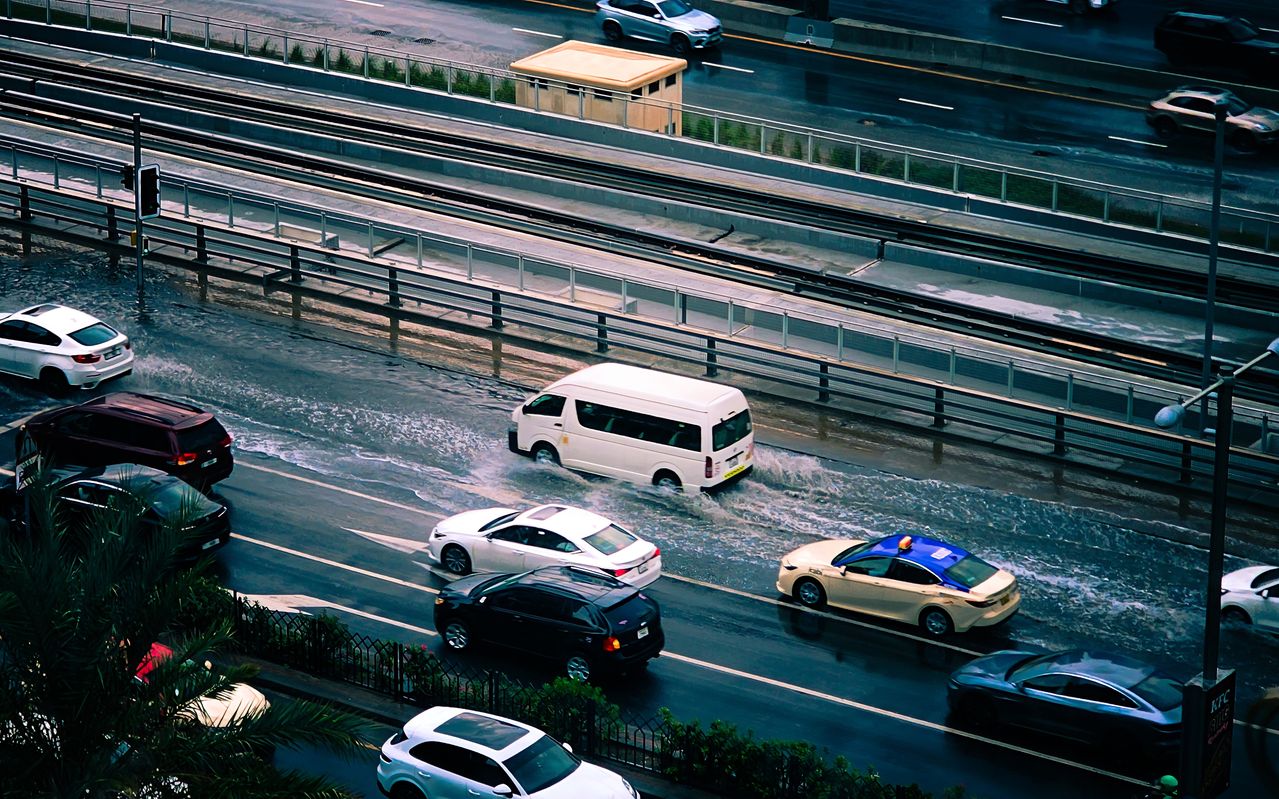
For many Kenyan drivers, the most dangerous part of a rainy day is not necessarily the rain itself. It is the water that collects on the road afterwards.
A familiar road can suddenly have a section covered in water. A pothole disappears beneath the surface. A drainage channel overflows. Traffic builds up as drivers try to work out whether the road ahead is passable. The temptation is often to watch another car go through and follow behind. That can be a very expensive decision.
The first thing every driver should understand about flooded roads is that you cannot always tell how deep the water is by looking at it. What appears to be a shallow pool may be hiding a deep pothole, a damaged section of road or an open drainage channel. Floodwater can also be moving underneath the surface in ways that are difficult to see.
Kenya’s Meteorological Department regularly warns motorists against driving through moving water during periods of heavy rainfall. It also points out that floodwater can appear in areas where there has been little or no rain locally, particularly downstream.
So the safest flooded road is often the one you decide not to enter. This becomes even more important when the water is moving. A vehicle has considerably less grip when surrounded by flowing water, and the force of the water can affect the vehicle’s stability. A driver may also lose the ability to see the road surface clearly.
If the water is flowing across the road, especially strongly enough to push debris, the best option is to turn around and find another route rather than trying to prove that your car can make it through.
The same applies when you cannot see the road underneath. A vehicle’s ground clearance may help in shallow water, but it does not tell you whether the road beneath the water is intact. An SUV with high clearance is not automatically a flood-proof vehicle. This is one of the most common misconceptions about driving through flooded roads.
Ground clearance tells you how high the body sits above the ground. It does not tell you how high the engine’s air intake is, how well the electrical system is protected or how deep the water actually is.
And that brings us to one of the most expensive things that can happen when a car enters deep water: water entering the engine. Engines need air to operate. If water is sucked into the engine through the air intake in sufficient quantity, it can cause a condition known as hydrolock.
Because water cannot be compressed like the air-fuel mixture normally found inside a cylinder, the resulting forces can cause serious internal engine damage. The result can be a repair bill running into hundreds of thousands of shillings, depending on the vehicle and extent of damage. That is a very different outcome from simply getting the exterior of the car dirty.
Water can also affect the transmission, wheel bearings, electrical connectors and other components underneath the vehicle. Modern vehicles have extensive electronic systems, and prolonged exposure to water can create problems that may not become obvious immediately.
The brakes deserve attention too. After driving through water, braking performance can temporarily feel different. The brake discs and pads may be wet, so the first few applications may not feel exactly as they normally do.
Once you are safely out of the flooded section, apply the brakes gently while maintaining a safe distance from other vehicles. This can help restore normal braking as the components dry. Do not, however, interpret this as a reason to drive quickly through the water. Speed is not your friend in a flooded section.
Driving fast can create a bow wave around the front of the vehicle and send water into areas you would rather keep dry. It can also reduce your ability to react to a pothole or obstacle hidden underneath the water.
If you absolutely have to cross a section of shallow standing water and you have a clear view of the road ahead, proceed slowly and steadily. Avoid sudden acceleration, harsh braking or unnecessary gear changes.
But there is an important distinction between shallow standing water that you can safely assess and water whose depth or movement you cannot determine. The second should be avoided.
Another mistake is following the vehicle in front too closely. A large vehicle such as a bus, truck or SUV can create significant waves as it moves through water. If you are directly behind it, those waves can temporarily cover your windscreen or push additional water toward your car.
Give yourself space. Visibility itself becomes a major problem during heavy rain. Water on the windscreen, spray from other vehicles and poor lighting can make it difficult to see lane markings, pedestrians, motorcycles and road hazards. Good wiper blades therefore become more than a convenience during the rainy season. They are part of your safety equipment.
Your headlights should also be working properly, even during the day when visibility is poor. Make sure the windscreen is clean inside and outside, because a dirty windscreen combined with water and oncoming headlights can create significant glare.
Floodwater can also hide dangers beyond the water itself. A road that has been flooded may have suffered damage underneath. The surface could have been washed away, weakened or undermined. Mud and debris may also be left behind after the water recedes. This is why a road that looks passable immediately after flooding may still be dangerous.
The same caution applies to bridges and low-lying crossings. Water levels can rise quickly, particularly when heavy rain has fallen upstream. You do not necessarily need to be standing in a rainstorm to encounter dangerous floodwater.
This is something Kenyan drivers should take seriously because flooding has repeatedly disrupted transport across different parts of the country. The Kenya Meteorological Department has documented cases where flooding affected roads and transport infrastructure, including in Nairobi and along major routes.
What if you have already driven through deep water and the car suddenly stops? Do not keep trying to start it repeatedly. If water has entered the engine, repeated attempts to start the vehicle can potentially make the damage worse. Move yourself and passengers to a safe location if possible and arrange for the vehicle to be assessed by a qualified mechanic or recovery service.
Even if the car starts afterwards, do not automatically assume everything is fine. Water may have entered fluids, electrical connections, wheel bearings or other components. A vehicle that survives a flooded road can still develop problems days or weeks later.
In Kenya, where heavy rainfall can cause flash flooding and disrupt roads with little warning, knowing when to turn around may be one of the most useful driving skills you have. Sometimes the safest way through a flooded road is not through it at all.