

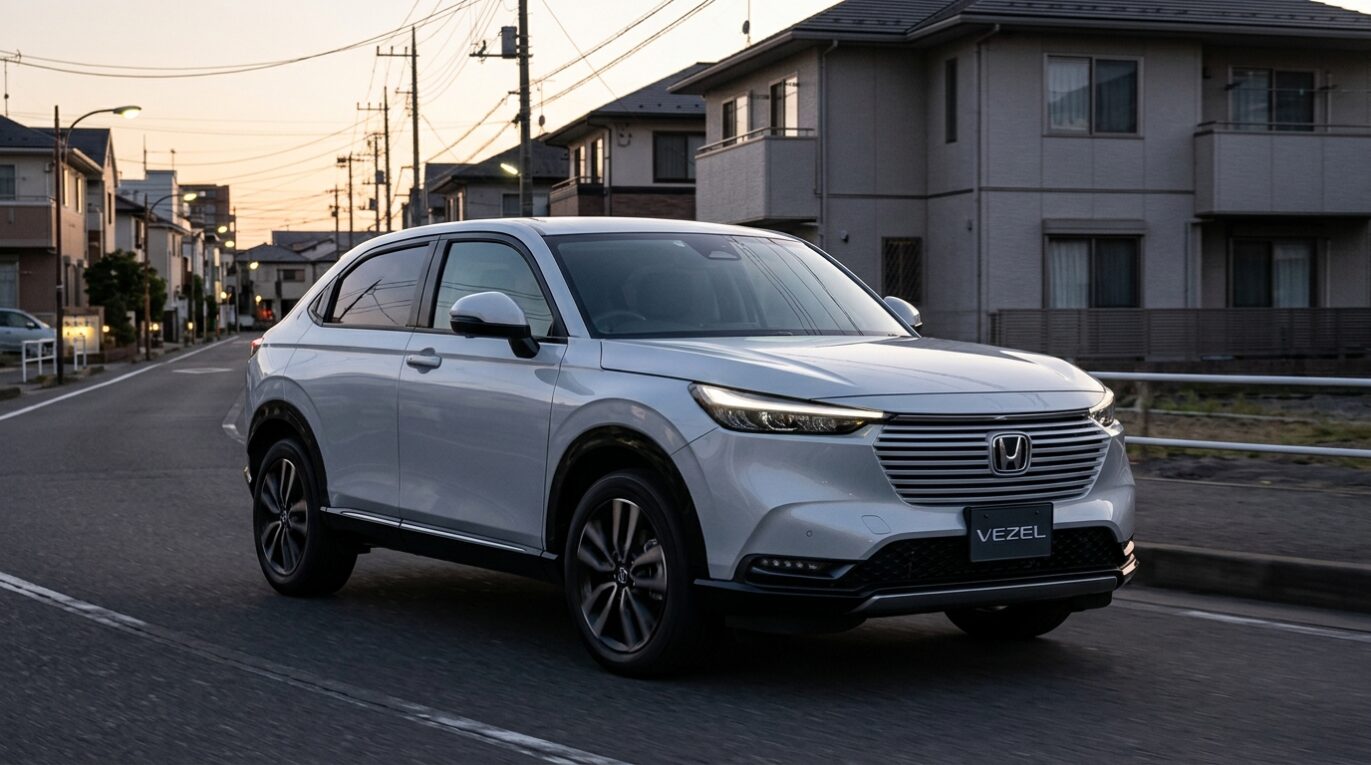
The Honda Vezel is one of those cars that quietly found its way into Kenya and never really left. You see it in Nairobi traffic, in estates, outside offices and increasingly on highways heading upcountry. It has the appearance of a small SUV, the fuel economy of a much smaller car and, importantly for many Kenyan buyers, the practicality to serve as a family car without becoming too bulky for everyday driving.
But the Vezel has also developed a slightly complicated reputation. Its hybrid system is often praised for fuel economy, while its dual-clutch transmission has made some buyers nervous. There are also plenty of different grades, engines and drivetrains in the Japanese market, meaning two Vezels parked next to each other aren’t necessarily the same car underneath. So, after years of becoming established in Kenya, is the Honda Vezel still a good buy?
A Small SUV That Gets the Packaging Right
The Vezel’s biggest strength is probably its size. It is compact enough to feel comfortable in Nairobi traffic and parking spaces, but it doesn’t feel like you’re driving a hatchback. The elevated seating position gives you a better view of the road, while the interior makes clever use of the available space.
Honda’s rear-seat design is particularly useful. The rear seats can be configured in different ways, allowing you to carry taller or bulkier items than you might expect from a vehicle of this size.
The first-generation Vezel also has a relatively generous boot, with about 435 litres of luggage capacity according to published specifications.

That combination explains much of its appeal. You get a compact footprint without giving up the practicality that makes people consider an SUV in the first place.
The 1.5-Litre Hybrid Is the One Many Kenyans Want
The Vezel comes in petrol and hybrid versions, but the 1.5-litre hybrid is particularly popular among Kenyan buyers.
The first-generation hybrid uses Honda’s i-DCD system, combining a 1.5-litre petrol engine with an electric motor and a seven-speed dual-clutch transmission. It is important to understand that this is not a conventional CVT hybrid like a Toyota Aqua or Fielder Hybrid.
That distinction matters because the driving experience and maintenance requirements are different.
The Vezel hybrid can feel surprisingly responsive around town. Electric assistance helps the car get moving without requiring the petrol engine to do all the work, while the relatively small engine keeps fuel consumption reasonable.
Real-world fuel economy will obviously depend on traffic, driving style, tyre condition, air conditioning and the health of the hybrid system. Claims of extremely high figures should therefore be treated cautiously. Honda itself notes that actual consumption varies with conditions, traffic, driving style and vehicle condition. For a Nairobi driver who spends a lot of time in traffic, however, the hybrid makes a lot of sense.
And Then There Is the DCT
This is probably the most important thing to understand before buying an older Vezel hybrid. The seven-speed dual-clutch transmission is very different from the CVTs found in many Toyota hybrids. It uses clutches to engage the gears, which gives the Vezel a more direct feel but also means the transmission needs to be properly maintained. This is where some of the Vezel’s bad reputation comes from.
There have been cases of transmission related problems, and incorrect maintenance can make matters worse. Kenyan specialists have specifically warned against treating the Vezel hybrid transmission like a Toyota-style CVT and putting the wrong fluid into it.
That doesn’t make the Vezel an unreliable car. It means you need to buy the right Vezel and maintain it correctly.
Before buying a used hybrid, pay attention to how the transmission behaves during a test drive. Hesitation, juddering, harsh engagement, warning lights or unusual noises deserve investigation rather than being dismissed as “normal Honda behavior.” And don’t buy one simply because the seller says, “The gearbox is okay.” Get it inspected.
Petrol Vezel vs Hybrid Vezel
The non-hybrid Vezel is worth considering if you want to avoid the additional complexity of the early hybrid system.
The petrol versions use Honda’s 1.5-litre petrol engine and CVT combination, depending on the particular model and market specification. They don’t deliver the same hybrid fuel-economy advantage, but they can appeal to buyers who prefer a more conventional powertrain.
The hybrid, on the other hand, is arguably the more interesting Vezel for someone who spends a lot of time in urban traffic. So this isn’t really a case of one being universally better.
If fuel economy is a major priority and you find a properly maintained hybrid, the hybrid makes a lot of sense. If simplicity and familiarity with conventional petrol powertrains matter more to you, the non-hybrid deserves consideration.
How Does It Handle Kenyan Roads?
The Vezel is a crossover, not a serious off-road vehicle. Ground clearance on the first-generation model is around 170 mm in typical configurations, with some four-wheel-drive versions offering more. That is adequate for normal urban driving and many Kenyan roads, but it doesn’t give you the freedom of a proper SUV.
You need to be sensible around deep potholes, badly designed speed bumps and rough roads.
The sporty RS versions can be even less appealing if your regular routes are particularly rough because their suspension and larger wheels prioritise handling and appearance more than maximum ride comfort.
For someone whose driving is mainly Nairobi, highways and reasonably maintained roads, the Vezel is perfectly comfortable in its element. For someone regularly travelling on very rough rural roads, there are better choices.
What About Reliability?
A properly maintained Vezel can be a reliable car. The bigger issue is that buying a used Japanese import means you are buying a vehicle with a previous history that you may not fully know. The condition of the hybrid battery, transmission, suspension and engine matters much more than the fact that the badge says Honda.
This is why the auction sheet and vehicle history matter. A cheap Vezel with questionable history can quickly stop being cheap once mechanical problems appear. On the other hand, paying a little more for a clean example with a verifiable history and good mechanical condition can make considerably more sense.
The same principle applies to any used car, but it is particularly important with a Vezel because the hybrid and DCT systems require knowledgeable maintenance.
How Much Does a Honda Vezel Cost in Kenya?
The market is quite broad. Current Nairobi listings show examples from around KSh 1.85 million for some older locally used cars to around KSh 2.6–2.7 million for newer foreign-used 2018–2019 hybrids, with many examples falling somewhere between those figures.
But don’t use those numbers as a fixed price list. A 2018 Vezel Hybrid with 120,000 km should not automatically be compared with a low-mileage 2018 foreign-used example. Likewise, 2WD and 4WD, hybrid and non-hybrid, standard and RS grades can all affect the price.
This is one of those cars where condition and specification can easily make a few hundred thousand shillings of difference.
Should You Buy One?
For the right buyer, yes. The Vezel offers a very attractive combination of compact dimensions, SUV-like driving position, good interior space, stylish looks and, in hybrid form, impressive potential fuel economy.
It is particularly well suited to someone who spends a lot of time in town but still wants enough space for a family and occasional highway trips.
But I wouldn’t recommend buying the cheapest Vezel you can find. The hybrid system and DCT deserve proper inspection, the vehicle’s history should be verified, and the car should be assessed by someone who actually understands Honda’s hybrid system rather than simply plugging in a generic scanner and declaring it healthy. That extra inspection could save you far more than it costs.
To conclude, the Honda Vezel isn’t perfect, but it has aged into a very compelling used-car option for Kenya. If you find a clean, properly maintained Vezel with a verifiable history and a healthy hybrid system, there is little reason to be scared of the badge.
Just remember that the Vezel is not a Toyota hybrid with a Honda badge. Its engineering is different, and it needs to be maintained accordingly. For a Kenyan buyer looking for a relatively compact crossover that can handle the daily commute without drinking fuel like a larger SUV, however, the Vezel remains a very interesting proposition.